
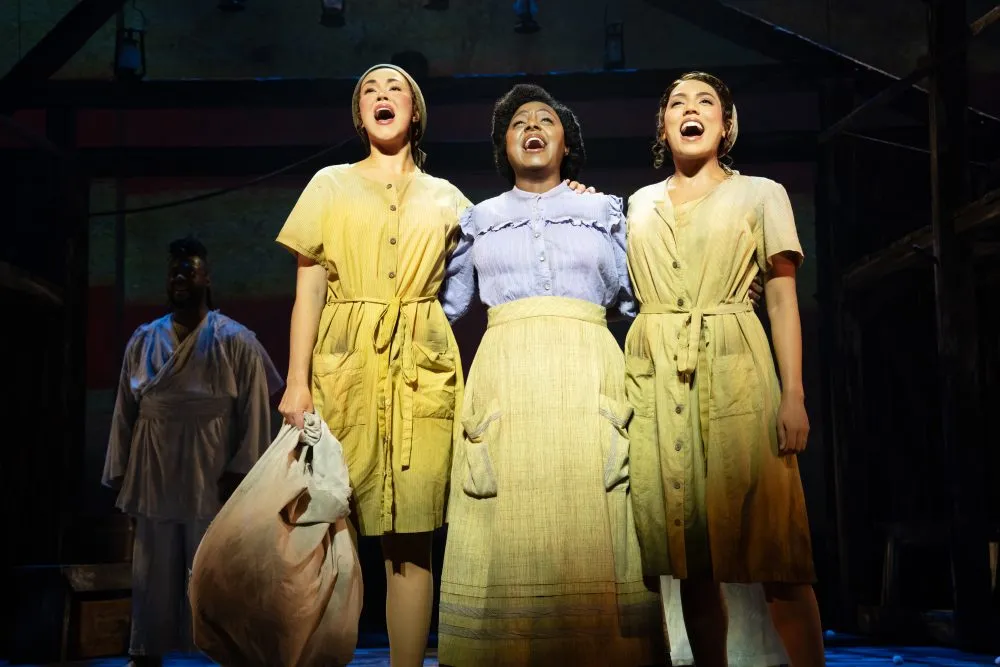
“Wanted” arrives on Broadway with a gripping premise, formidable voices and a family story drawn from playwright and lyricist Angelica Chéri’s own history. Yet the musical’s dramatic potential never fully catches fire.
Directed by Stevie Walker-Webb, the production is inspired by Chéri’s great-great aunts, Mary and Martha Clarke, played by Solea Pfeiffer and Liisi LaFontaine. The Black sisters live in post-emancipation Texas, where they decide to pass as white and use both their beauty and guns in an effort to protect their family’s land and legacy.
That setup promises a bracing story about race, survival and outlaw rebellion. In practice, “Wanted” gradually shifts its attention away from the sisters’ criminal exploits and the consequences of passing, placing increasingly greater weight on two romantic relationships.
A Family’s Fight Becomes an Outlaw Tale
The Kinfolk ensemble ushers the audience into the story in 1893, in a cotton field in Marlon, Texas. Mary and Martha have spent years working and saving alongside their mother, Tallulah, played with commanding force by Ledisi. The sharecropping family hopes to purchase the property the Clarkes have tended for generations.
When the sisters offer landowner Mr. Billingsley, played by Nathan Quay Thomas, $200 for the property, his racist anger erupts. He refuses the money, declares that the family is behind on rent and demands twice that amount under threat of eviction.
Mary and Martha see an opportunity in their pale skin, inherited from their long-absent French father. They leave Marlon’s country roads behind to raise enough money to prevent their family from losing everything. Traveling through the 19th-century American South as single women makes them immediate targets, but they are not defenseless: They carry Tallulah’s pistol, Ole Bessie.
The sisters soon learn that intimidation and theft bring in money more quickly than other work. A few stick-ups, along with seduction and deception, give the show flashes of the dangerous adventure its premise suggests. Their path eventually leads them to a saloon belonging to notorious owner Jesse Banks, played by Bradley Jaden, who quickly becomes interested in Mary.
But the outlaw thread loses momentum just as it should be intensifying. Mary falls for Jesse, a wealthy white man who does not know she is Black. Martha, meanwhile, is reluctantly drawn to Elijah, a Black man employed by Jesse and played by Luke James. The sisters’ relationships with the two men become the main source of conflict between them.
That choice makes “Wanted” feel more conventional than its opening promises. The Clarkes never become the fully realized outlaws the musical initially appears ready to unleash, while the rushed love story crowds out deeper consideration of their rebellion and its risks.
The Performers Supply the Power
Where the book struggles, the cast delivers. Pfeiffer, LaFontaine and Ledisi bring exceptional vocal talent to the production, and their singing becomes the element holding the musical together.
An orchestra led by Paul Byssainthe, Jr. supports the show’s strongest musical moments. “Inheritance” and “Mary’s Nightmare” emerge as standout numbers, although the remaining songs and lyrics do not consistently land with the same impact.
The visual design also helps give the production dimension. Beowulf Boritt’s scenic work, paired with Stefania Bulbarella’s video and projection design, establishes a stronger sense of the period and setting. Those elements add texture to a story whose many themes compete for space.
Passing as both resistance and self-preservation is inherently compelling, but “Wanted” does not find a sufficiently fresh approach to the subject. Similar territory has been explored in the 1934 and 1959 versions of “Imitation of Life,” Brit Bennett’s book “The Vanishing Half” and Nella Larsen’s “Passing.” Mary’s journey here offers little that feels newly revealing. Worse, she increasingly comes across as dangerously naive and confoundingly selfish rather than the formidable criminal introduced at the outset.
ShowBiz Take
“Wanted” matters because its central inspiration contains the makings of a distinctive American story: Two Black women in post-emancipation Texas use passing, strategy and force while fighting for land their family has worked for generations. That is potent material, and the connection to Chéri’s own great-great aunts gives the project an especially personal foundation.
But an overpacked book leaves the musical uncertain about which part of that story should command the stage. The family’s fight for property, the sisters’ outlaw transformation, the emotional cost of passing and the romantic plotlines all pull in different directions. By leaning most heavily on love, the show diminishes the very qualities that could have made Mary and Martha’s account stand apart.
As a showcase for extraordinary voices, “Wanted” has undeniable appeal. Its best songs, accomplished orchestra and atmospheric design demonstrate what the production can do. As a fully formed Broadway narrative, however, it never turns its provocative premise into an equally powerful story. The cast ignites the material whenever it can; the musical around them remains frustratingly unfocused.