
Why This Matters
Brenda Fricker’s death in Dublin on Thursday closes a singular chapter in Irish and international screen history. The actor, whose representative Phil Belfield confirmed the news to the BBC, was 81. For many filmgoers, she remains inseparable from two very different but enduring roles: the fiercely compassionate mother in Jim Sheridan’s “My Left Foot” and the mysterious, wounded Central Park bird keeper in “Home Alone 2: Lost in New York.” Together, those performances captured the unusual range of a performer who could be severe, tender, funny and quietly devastating within the span of a single scene.
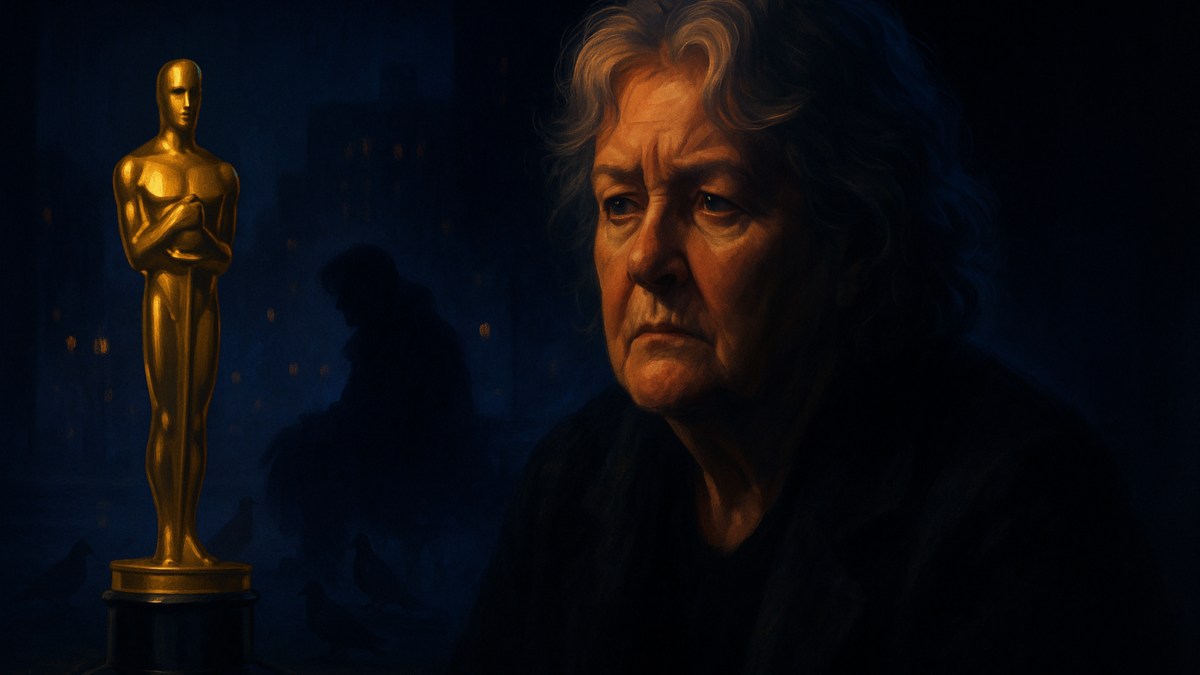
Fricker’s Academy Award win for “My Left Foot” was a landmark moment. Playing Bridget Fagan Brown opposite Daniel Day-Lewis, she became the first Irish actress to receive an Oscar, helping elevate both Irish cinema and Irish performers on a global stage. The film, which dramatized the life of writer and artist Christy Brown, arrived at a time when Ireland’s film sector was still fighting for broader international recognition. Fricker’s win did more than honor one performance; it signaled that Irish stories, accents and working-class characters could carry serious awards weight in Hollywood.
Her work mattered because it resisted glamour in favor of truth. Fricker specialized in characters whose resilience had been hard-earned. She could communicate years of disappointment, loyalty or grief without underlining a moment, and she often brought dignity to women who might otherwise have been treated as background figures. That instinct made her a valuable presence in dramas, comedies and family films alike. Even in a blockbuster holiday sequel, she found emotional depth in a character who might have been reduced to a whimsical eccentric.
Belfield paid tribute to her as an irreplaceable talent, saying the world was diminished by her absence. That sentiment is likely to be widely shared across film, television and theater communities in Ireland, the U.K. and the U.S. Fricker belonged to a generation of performers whose reputations were built not on celebrity machinery but on craft, stage discipline and an ability to disappear into a role.
Industry Context
Fricker’s career unfolded across several eras of the entertainment business. Before international audiences came to know her through awards season and studio comedy, she had already established herself in British and Irish television, most notably through “Casualty,” where she appeared as nurse Megan Roach. Her work on the medical drama demonstrated the qualities that would define her career: emotional intelligence, an unforced naturalism and a grounded screen presence that made even procedural storytelling feel lived-in.
“My Left Foot,” released in 1989, became a pivotal film not only for Fricker but for a wave of Irish talent that would go on to reshape prestige cinema. Directed by Sheridan and led by Day-Lewis in an Oscar-winning performance, the film positioned Irish storytelling within the center of the awards conversation. Fricker’s supporting actress victory remains one of the defining achievements of that period, especially because it honored a performance built around maternal complexity rather than showy transformation.
Her later appearance in “Home Alone 2” introduced her to a different audience altogether. As the Pigeon Lady, Fricker gave the family comedy one of its most unexpectedly poignant notes. The character’s friendship with Macaulay Culkin’s Kevin McCallister offered the film a measure of melancholy amid its slapstick set pieces and holiday spectacle. It is a testament to Fricker’s skill that viewers who first encountered her in that role often remembered the character not as a novelty, but as the emotional heart of the movie.
Across her body of work, Fricker occupied a space that the industry has not always known how to protect: the character actor whose contributions are essential, even when they are not positioned at the center of marketing campaigns. She was not a performer defined by volume or vanity. Instead, she worked from the inside out, building characters whose pain and humor felt recognizable. In an era increasingly driven by franchises, algorithms and personal brands, her career is a reminder of the power of actors who serve the story first.
Her death also arrives as Irish talent continues to enjoy an extraordinary global profile, from Oscar contenders to streaming breakouts and international co-productions. The current visibility of Irish actors, writers and directors was built in part on the breakthroughs of artists like Fricker, who helped prove that work rooted in specific local experience could resonate internationally. Her Oscar win remains a milestone frequently cited in conversations about Ireland’s expanding influence in film and television.
What Happens Next?
In the coming days, tributes are expected from colleagues, institutions and admirers who worked with Fricker or were shaped by her performances. Irish cultural organizations and film bodies are likely to acknowledge her role in bringing national talent to a wider audience, while broadcasters and streaming platforms may see renewed interest in “My Left Foot,” “Casualty” and “Home Alone 2.” For many viewers, revisiting her work will be the most immediate way to understand the breadth of what she contributed.
There will also be fresh attention on the historical significance of her Oscar victory. Awards milestones can sometimes become flattened into trivia, but Fricker’s win represented a meaningful shift in who was being recognized by Hollywood at the time. It helped create a path for future Irish performers to be considered not as outsiders to the awards establishment, but as central figures within it.
Her legacy will likely be measured less by volume than by permanence. Fricker did not need dozens of iconic roles to leave an imprint; she had a handful that continue to travel across generations. Whether remembered as the mother whose love is tested by hardship or as the lonely woman in the park who teaches a child about trust, she brought humanity to the screen with rare precision.
As the industry marks her passing, the focus now turns to preservation and remembrance: the interviews, performances and personal accounts that will help frame her place in film history. Brenda Fricker leaves behind a career defined by empathy, rigor and emotional truth — qualities that remain as valuable onscreen now as when she first found international acclaim.