
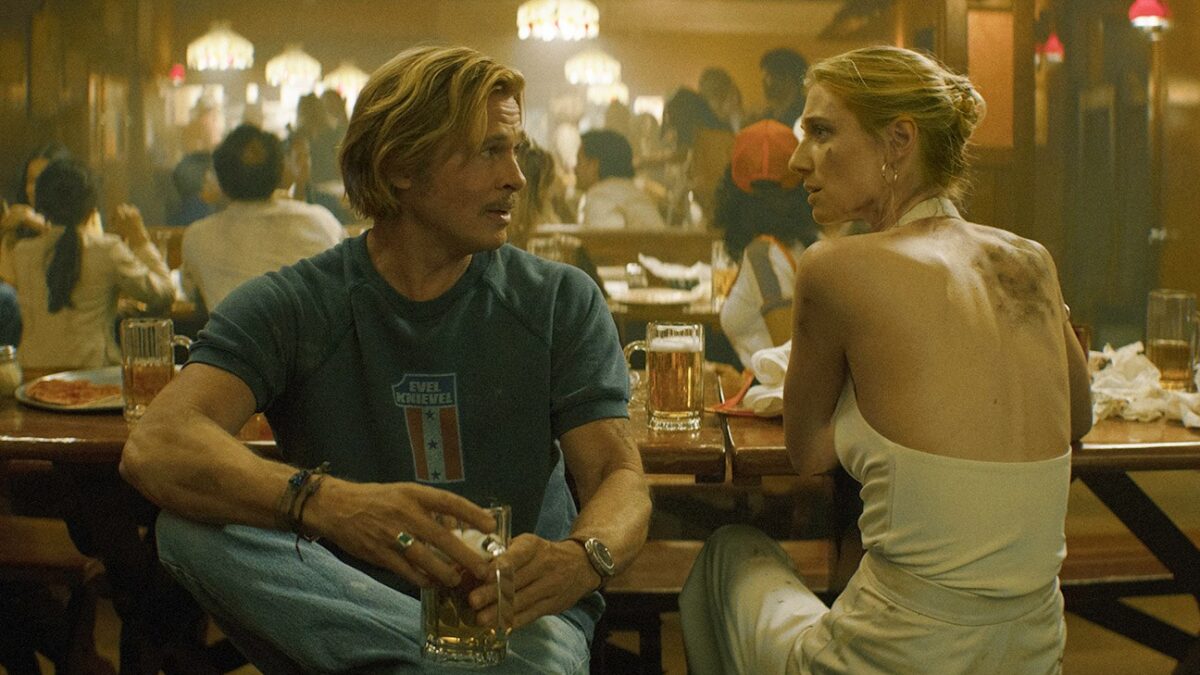
Brad Pitt’s Cliff Booth steps out of sidekick territory in The Further Mis-Adventures of Cliff Booth, a standalone chapter that pairs the character’s unhurried cool with a spectacularly bloody final act. Directed by David Fincher from Quentin Tarantino’s screenplay, the R-rated film runs 2 hours and 23 minutes and opens in theaters on Wednesday, Nov. 25, before streaming on Netflix on Wednesday, Dec. 23.
The movie finds Pitt revisiting the role that won him an Oscar in Once Upon a Time in Hollywood. Eight years have passed since Cliff and fading television star Rick Dalton confronted three murderous Manson followers. Rick is now working in Australia on a series called Dingo Dan, while Cliff has aged out of stunt work without exactly settling into a quiet retirement.
Cliff Booth Keeps Busy
Cliff works as a projectionist at the New Beverly Cinema, where he has memorized the dialogue from the fictional blaxploitation hit Soul Brothers Die Hard. That movie stars Roderick “Hot Rod” Harrison, a former Oakland Raiders player portrayed by Yahya Abdul-Mateen II.
His other jobs are considerably less conventional. Cliff mixes cocktails at a rowdy Redondo Beach tiki bar featuring women’s mud-wrestling contests, takes occasional day-player work on adult films such as The Sexorcist and enters punishing demolition derbies for recreation.
His most lucrative off-the-books occupation, however, is working as a fixer for wealthy Los Angeles residents. One assignment involves recovering stolen jewelry and a best director Oscar from Joey, a young hustler played by Corey Fogelmanis. When Joey and his associate Chicken Hawk, played by Karren Karagulian, arrive to trade the property for cash, Cliff reshapes the deal without hesitation or remorse.
Unlike the man-of-few-words seen alongside Rick Dalton, this version of Cliff is notably more talkative. The film initially moves through a loose collection of episodes, shifting between times and Los Angeles neighborhoods as it blends crime, romance, dark comedy and a late-1970s hangout atmosphere.
A Dangerous Job Comes Calling
The central story begins when talent agent Karen Crosby, played by Elizabeth Debicki, contacts Cliff on behalf of her client Charlie Peters. Scott Caan plays Charlie, a television star famous for performing his own stunts in programs with titles including Fireball Jungle, Tom Horn: Stock Detective and Enemy Territory.
Charlie’s problem involves brothers Eddie and Fernando Verdusco, played by Matt Groove and JB Tadena. The gangsters have traveled from the Philippines to complete a violent assignment Charlie gave them during a drunken night while filming there. Charlie has attempted to withdraw the order, but the brothers intend to finish the job and get paid.
The situation also threatens Hot Rod, who is working with Charlie on the private-eye television movie Disco Kingpin. Cliff has his own history with the Philippines, having served there during World War II while the country was under Japanese occupation.
As the danger builds, the movie devotes equal attention to Cliff’s slow-burning pursuit of Karen and his playful exchanges with Charlie’s wife, Toni, played by Carla Gugino. Cliff and Toni previously had a fling while working on the Rick Dalton project Salty the Talking Sea Otter, something Charlie does not know. A doubles tennis match involving all four characters becomes important to the plot’s later complications.
Performances and Period Style
Pitt remains the movie’s essential ingredient, carrying its tangents through Cliff’s grin, cowboy gait and seemingly unshakable composure. The character now walks with a limp, his body marked by decades of stunt work, but he remains magnetic even when the episodic storytelling feels less substantial than the 2019 film.
Debicki, using her native accent, gives Karen a commanding mix of intelligence and sensual confidence, while Caan plays Charlie’s excitable energy against Cliff’s relaxed manner. Gugino makes Toni both perceptive and flirtatious, and Abdul-Mateen embraces the outrageous fictional film and television scenes built around Hot Rod.
Peter Weller supplies another important performance as Cliff’s father, Gus. The two share an apartment in a sprawling Marina del Rey complex. Gus runs a pawn shop, watches an endless rotation of television and mainly wants his son to feed the cat and stop blocking the screen, but their sharp exchanges do not conceal their affection.
Fincher and cinematographer Erik Messerschmidt shot digitally, departing from Tarantino’s preference for celluloid and giving the period setting a dark, grimy, noir-inflected look. Trent Reznor and Atticus Ross provide the score, while Ren Klyce’s layered sound design incorporates an extensive selection of songs. Electric Light Orchestra’s “Tightrope” accompanies one violent sequence, two Donna Summer tracks appear, and Boz Scaggs’ “Lowdown” opens the end credits.
Production designer Don Burt and costume designer Trish Summerville fill the film with period details without pushing the late-1970s aesthetic into kitsch. The credited ensemble also includes Lauren Glazier, Timothy Olyphant and Nicholas Hammond.
ShowBiz Take
The Further Mis-Adventures of Cliff Booth matters because it transforms a former supporting character into the center of his own pulp-style mythology. Fincher’s controlled visual approach and Tarantino’s shaggy, tangent-friendly writing do not always fit seamlessly, but Pitt supplies the connective force. The result is less robust as a feature-length narrative than its predecessor, yet its mixture of Hollywood nostalgia, crime, romance and savage violence remains consistently entertaining.
What Happens Next?
Audiences can first see Cliff’s latest misadventure in theaters, including IMAX, beginning Nov. 25. The film will then move to Netflix on Dec. 23.