
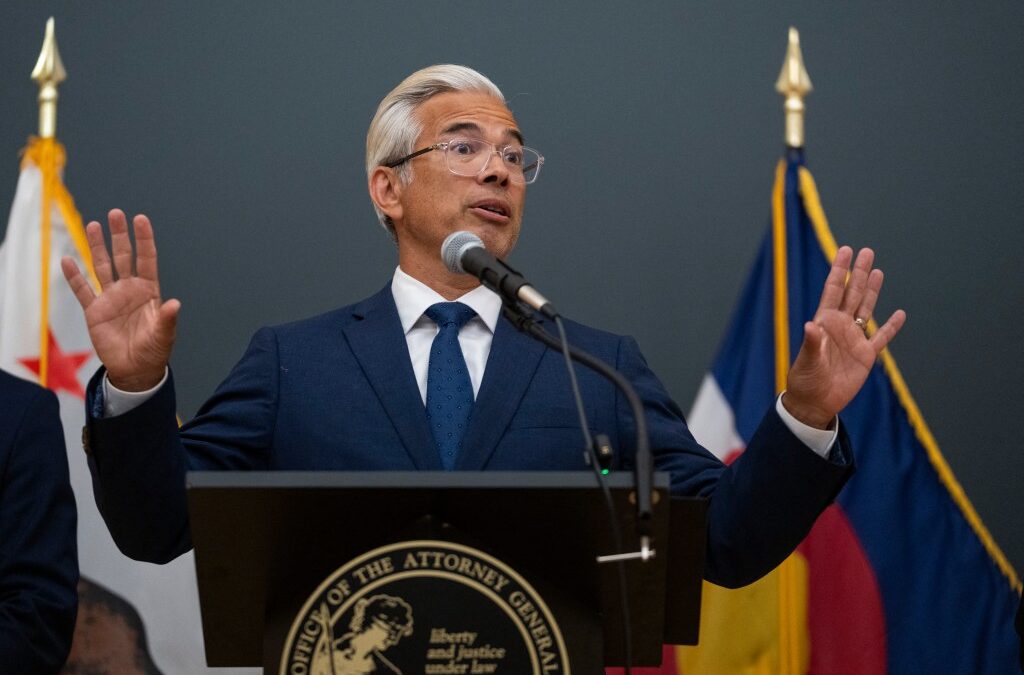
California Attorney General Rob Bonta is sharply defending the multistate legal challenge to Paramount’s proposed merger with Warner Bros. Discovery, saying state enforcers moved in because they did not believe federal regulators had done enough.
Speaking at The Atlantic Festival in New York, Bonta said the 12 Attorneys General suing to block the deal conducted their own review after the Department of Justice cleared the merger in June.
“We, respectfully, didn’t think that the United States DOJ did an adequate review and we thought we needed to step in to make sure we were protecting consumers,” Bonta said.
The California AG described the case as straightforward from the states’ perspective. “When we looked at, it was and continues to be, a black-and-white, bread-and-butter case,” he said. “We looked at the facts. We looked at the law. We did our own independent assessment of the law, the facts, and we decided that there was an antitrust violation in three separate markets we set forth in our complaint.”
Bonta appeared on a panel of state Attorneys General alongside New Hampshire Attorney General John Formella and Pennsylvania Attorney General David Sunday. The discussion centered on the expanding role of AGs in antitrust and consumer protection fights, including recent high-profile cases involving Live Nation-Ticketmaster, Nexstar-Tegna and Meta.
For Bonta, the Paramount-Warner Bros. Discovery fight is tied directly to consumer prices, access and competition in entertainment. He said the states acted to protect “consumers, who are paying satellite bills and cable bills” as well as moviegoers “trying to enjoy one of the joys of life and go to the movies.” He added that the states want to make sure costs are not raised, jobs are protected and choices remain competitive in the marketplace.
California Exit Threats Draw a Blunt Response
The lawsuit is already reshaping the timetable for the proposed combination. The case is set for trial in March, and the Attorneys General secured a temporary restraining order early in the process. Paramount has agreed to delay closing the deal until next summer.
The court has also ordered two days of settlement talks in October, though the sides remain far apart. Against that backdrop, David Ellison this week escalated threats to pull Paramount out of California if the litigation continues to hold up the transaction.
Bonta declined to dictate what Paramount should do, but made clear where he believes responsibility would lie if the company leaves the state.
“There have been threats, those aren’t new. The continued threats to leave the state of California. I can’t comment on what a company decides to do, especially a company that has professed a commitment to Hollywood and to California,” Bonta said. “If they make that choice to leave, that is their choice and their choice alone. They own it. It lies at their feet.”
At the same time, Bonta said the states remain open to talks if there is a serious path to a resolution. “We have a job to enforce the law without fear, without favor, and at the same time, we are always open to coming to the table if it is in good faith and sincere,” he said, adding that the states would explore any opportunity to achieve the results they want “based on our evaluation of the case at the table.”
The $1.88 Billion Bond Fight
A separate flashpoint is Paramount’s demand that the plaintiffs post a $1.88 billion bond. Bonta rejected the argument, saying, “What I think that is they don’t have any right to that. In our view. I think that’s buyer’s remorse.”
He also said there was “no part of the agreement” with the court that required the states to post a bond. “They’re trying to rewrite an agreement, a commitment, a promise that they already made, and we feel very confident going into a hearing,” Bonta said. “The judge will decide.”
That decision is expected at a Sept. 24 hearing.
The bond request is tied to a ticking fee Paramount agreed to pay Warner as part of the merger terms. If the merger has not closed by Oct. 1, the fee begins accruing at $7 million per day. By early June, that would total $1.88 billion. At that point, either side can walk away. If that happens, Paramount would owe Warner Bros. Discovery a $7 billion termination fee instead of the ticking fee.
The Department of Justice filed a brief in the case docket this week supporting Paramount’s right to a bond. Paramount maintains that it is statutorily entitled to one.
Paramount has defended the merger, which was announced in February, as beneficial for the entertainment industry. The company has also committed to making 30 films a year between the two studios.
For now, the next immediate marker is the Sept. 24 bond hearing, followed by the court-ordered settlement talks in October. If no agreement is reached, the antitrust trial remains set for March, with the delayed closing timetable pushing the proposed deal into next summer.