
Spoiler warning: This article contains details from “Blade Runner 2099” Episode 1.
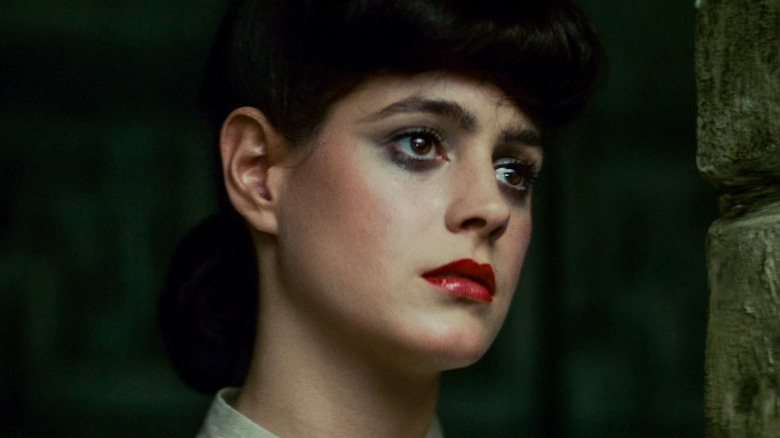
“Blade Runner 2099” wastes little time establishing its connection to the original film. Within the Prime Video series’ first 15 minutes, the premiere slips in a visual tribute to Rachael, the replicant played by Sean Young in the 1982 movie.
The reference arrives during Cora’s frantic escape from replicants hunting unregistered humans. After narrowly getting away, Hunter Schafer’s character rushes into an administrative office belonging to her friend Bebeto, played by Dimitri Abold.
Bebeto is already helping another woman when Cora enters. With her carefully arranged hairstyle and formal office clothing, the stranger closely resembles Rachael. The resemblance is deliberate enough to catch the attention of longtime viewers, but the episode does not suggest that she is literally Young’s character.
Cora looks at a display screen and identifies the woman as Deidre Lawson. Deidre is an ordinary person who becomes briefly entangled in Cora’s escape attempt before the story moves on.
That makes the moment an Easter egg rather than a surprise return. It also allows the premiere to echo Rachael’s distinctive appearance across the 80 years that have passed in the story since audiences first met her and Rick Deckard, played by Harrison Ford.
A Familiar World With the Power Structure Reversed
The Rachael nod helps connect “Blade Runner 2099” to the movies associated with Ridley Scott and Denis Villeneuve, even as the series radically changes the balance between humans and replicants.
In the films, Blade Runners pursue rogue replicants. By the time of the new series, however, replicants have risen against humanity and taken control. Unregistered humans are now the ones being hunted, placing them in the vulnerable position once occupied by the artificial beings.
Cora’s place in that new order drives much of the series. Although she is human, she poses as a replicant while trying to discover what the Blade Runners are doing. Her deception becomes more difficult when she is partnered with Olwen, a veteran Blade Runner played by Michelle Yeoh.
The pairing gives the series another way to revisit a central question in the franchise: whether anyone can reliably distinguish a human from a replicant.
Creator Silka Luisa explained that uncertainty in an interview with Den of Geek.
“I think the idea that you can’t tell a replicant from a human is baked into the franchise,” Luisa said. “It’s important because as an audience member, you can never really get on completely solid ground, because you never know who anyone is, and that puts you in the mindset of the characters in the show.”
The brief appearance of Deidre plays directly into that unease. She looks enough like a major replicant character to invite questions, yet the premiere identifies her as a normal woman. For a series built around unstable identities and reversed social roles, the visual misdirection fits neatly into the larger story.
ShowBiz Take
The smartest part of the Rachael Easter egg is its restraint. “Blade Runner 2099” does not turn Deidre into an elaborate mystery or claim that Rachael has somehow resurfaced. Instead, it uses costume and styling to acknowledge the original movie while keeping the focus on Cora’s immediate danger.
That choice also illustrates how the show is balancing continuity with reinvention. Rachael’s look remains recognizable eight decades later, but the world around it has been transformed. Replicants now hold power, humans are being pursued, and Cora must conceal what she is in order to survive and investigate the Blade Runners.
Rather than depending on the reference for its plot, the premiere makes it a reward for attentive viewers. New audiences can understand Deidre’s role without recognizing the resemblance, while established fans receive a quiet link to Sean Young’s character.
What Happens Next?
The series is set to continue following Cora’s attempt to pass as a replicant and uncover the Blade Runners’ activities. Her partnership with the experienced Olwen raises the stakes of that deception, particularly in a story where neither the characters nor the audience can always be certain who is human.