
Billie Eilish and burning oil fields became unlikely visual reference points for Laika’s Wildwood, as the filmmakers blended painstaking stop-motion performances with digital effects to build the animated film’s world.
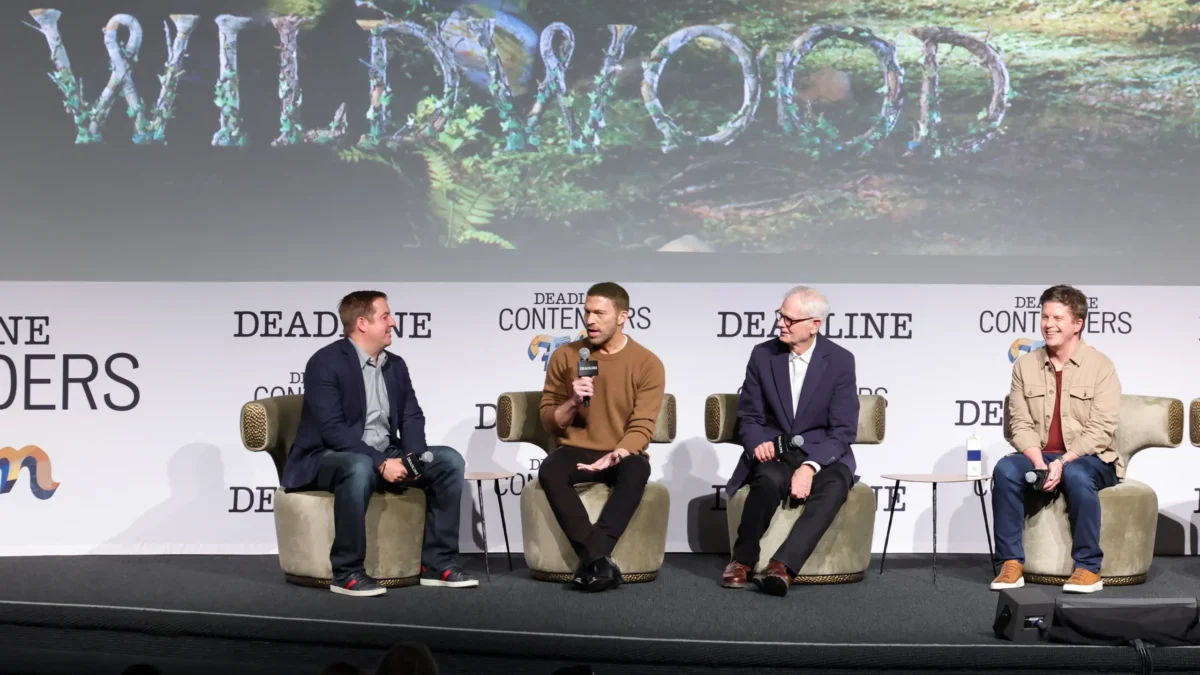
Director Travis Knight, cinematographer Caleb Deschanel and visual effects supervisor Steve Emerson discussed that process at Contenders Film Los Angeles, revealing how practical models, real-world footage and extensive advance planning informed everything from the lighting to the climactic battle.
Deschanel faced an unusual challenge: He needed to design shots before the movie’s characters were finished. He initially conducted a test shoot using Norman from Laika’s ParaNorman, then recruited another miniature stand-in.
“I found this Billie Eilish doll, I ordered it, I brought it into the sets and would play around with the lighting,” Deschanel said.
The pop star’s doll was only one part of a much larger technical undertaking. Based on Colin Meloy’s book, Wildwood follows Prue, voiced by Peyton Elizabeth Lee, as she sets out to rescue her brother. Curtis, voiced by Jacob Tremblay, joins her on the mission, which ultimately leads to an epic final battle.
Building a Stop-Motion Hellscape
Knight spent 16 years determining both how to adapt the book and how to realize the visions described by Meloy and illustrated by Carson Ellis. That adaptation required the filmmaker to consolidate some material while inventing other elements.
The finale demanded particularly careful preparation. Because stop-motion production does not allow filmmakers to capture extra coverage in the conventional sense, the battle had to be thoroughly storyboarded before animation began. Unused footage would represent a costly investment of time, while changing an angle after the fact could mean weeks of additional work.
“When you’re making a stop-motion movie, you cannot shoot any coverage,” Knight said. “If the angle wasn’t quite right, we need to widen out, you can’t do that. That would take an animator three weeks to reshoot.”
Knight described the finished confrontation as “a ballet between the practical and the digital.” Emerson said the director’s plan was for the action to escalate into a hellscape, giving the visual-effects team an array of tools to shape the sequence.
“That meant we had shadow, fire, light, atmospherics, all these elements at our disposal that we could use in order to create not only a beautiful, artful frame, but put the audience’s eye where we want them to look, which was at those stop-motion performances,” Emerson said.
For the sequence’s fiery environment, Deschanel studied footage of the Kuwait oil fires featured in the 1992 IMAX film Fires of Kuwait. The heavy smoke and darkness helped inform his approach to the scene, although his original concept evolved during conversations with Knight.
“There was all this smoke that was really dark that would cover over in the middle of the day,” Deschanel said. “I had this idea of occasionally sunlight coming through, but then Travis didn’t like that idea and ended up creating this incredible dark space that ended up being better. At the end, I managed to get some sunlight in there.”
Digital Effects Rooted in Practical Craft
Although Wildwood uses visual effects alongside frame-by-frame animation, Emerson emphasized that the digital work remained tied to the physical models and methods used by Laika’s stop-motion artists.
“There are no digital elements not being informed by practical elements,” Emerson said. “We need the stop-motion filmmakers in order to be able to do this work.”
The level of technical expertise involved prompted Knight to joke about where else his collaborators might direct their talents.
“These people are incredibly brilliant and they could be curing disease or developing sustainable energy,” he said. “Instead, they’re helping me make a puppet look sad.”
Beneath the joke, Knight also addressed the difficulty of bringing ambitious animation to the screen. He said little has changed since Laika began, noting that both Coraline and Wildwood were fights to get made. He linked the increasing difficulty of making projects to consolidation and argued that creative work requires active support.
“Art needs advocacy. It needs champions,” Knight said. “That’s what we’re trying to do at the studio. We’re one voice. Others will join us. We have to.”
ShowBiz Take
The production details behind Wildwood demonstrate why stop-motion remains such a demanding form of filmmaking. A Billie Eilish doll could help test lighting before the actual characters were ready, but once animation started, a camera adjustment could carry a three-week price in labor. That makes the detailed storyboarding of the final battle more than a creative choice; it was essential to realizing the sequence.
The filmmakers’ comments also show that Laika does not treat practical animation and digital effects as competing approaches. Emerson’s team used fire, shadow, atmosphere and light to expand the frame, but the stop-motion performances remained the focal point and the physical models continued to guide the digital work.
Deschanel, meanwhile, argued for a wider view of what animated storytelling can accomplish. “Animation doesn’t just have to be for small children,” he said. “The possibility for creating wonderful, deep stories are there.”