
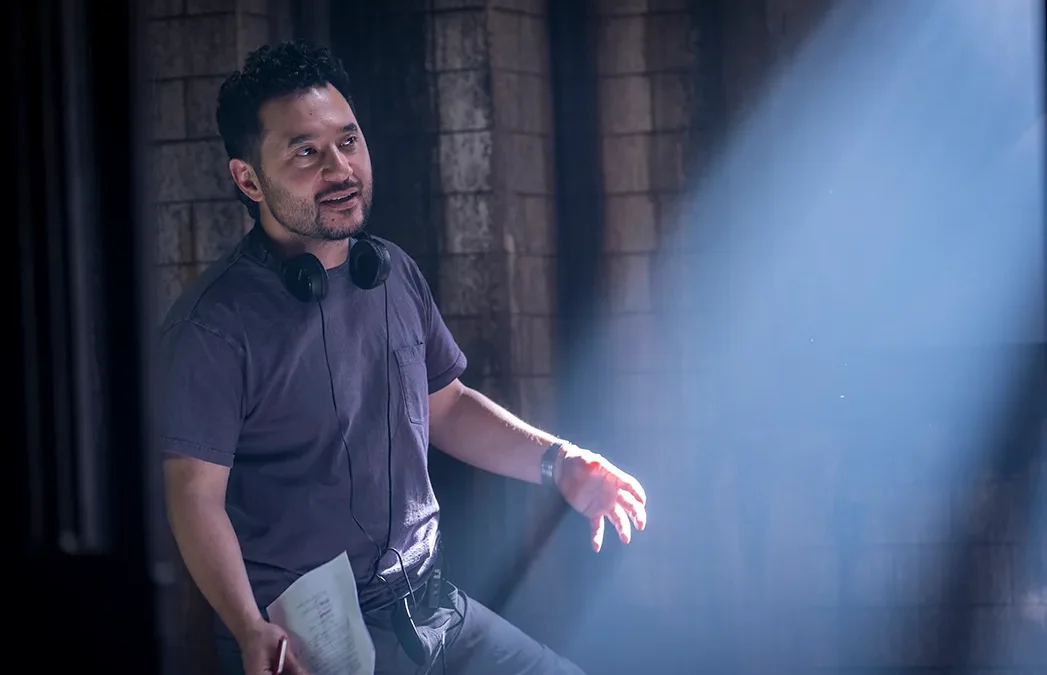
Before Kitao Sakurai directed the number-one movie in America, he was a teenage actor on rollerblades, wielding a hockey stick as one of the demonic Stygian Triplets in Kevin Smith’s 1999 religious satire Dogma.
Sakurai, then based in Cleveland, appeared in a blue Highlands Clamdiggers jersey and helped unleash the triplets’ mayhem on characters played by Bud Cort and Chris Rock. The unusual part now looks like an early marker of the absurdist instincts that would eventually carry him through The Eric Andre Show, Bad Trip and his latest film, Street Fighter.
In an interview with The Hollywood Reporter, Sakurai said acting was his first route into the entertainment industry. A shy child growing up in Ohio, he attended Japanese Saturday school and experienced what he called a “huge awakening” after being cast in a play. A local agent later connected him with Dogma, which Smith filmed mostly in Pittsburgh.
“I auditioned and got the role of one of the Stygian Triplets who beats up Bud Cort, which was incredible,” Sakurai recalled.
Dogma became a turning point, though not because Sakurai lost interest in performing. Instead, he grew increasingly absorbed by cinematography, photography and directing. Screenings of Jackie Chan, Jet Li and Robert Altman at the Cleveland Cinematheque fueled that interest, while a darkroom he built in his basement gave him another way to explore image-making.
At 19, Sakurai left college and moved to New York to pursue independent filmmaking, initially working primarily as a cinematographer. His early projects included low-budget music videos, one of which introduced him to Eric André in the mid-2000s. Sakurai was using vintage tube cameras purchased through a camera house from Dolly Parton’s estate, and André responded to the visual style.
From an “Anti-Talk Show” to Feature Films
Sakurai and André subsequently developed a proof of concept for The Eric Andre Show. After networks repeatedly passed, they expected to release the project themselves on YouTube. Adult Swim ultimately picked it up in 2010, beginning a collaboration that has produced 60 episodes, several specials and an Emmy win.
That same year, Sakurai debuted his first feature, Aardvark. The experimental film fictionalized the real-life relationship between Larry Lewis Jr., a blind recovering alcoholic, and jiu-jitsu instructor Darren Branch, before shifting from docu-narrative into revenge thriller territory.
His second feature, Bad Trip, expanded his work with André. The hidden-camera buddy comedy starred André and Lil Rel Howery as best friends traveling to New York City, with staged, in-character pranks involving unsuspecting members of the public incorporated into the story.
The movie’s release became complicated. Initially scheduled for a 2019 theatrical launch through MGM’s Orion Pictures, it moved to 2020 and was set for a March premiere at South by Southwest. The pandemic disrupted both that event and the planned theatrical release. Amazon Prime Video also accidentally made the film available before Netflix acquired it for streaming in 2021.
Although Sakurai remained disappointed that Bad Trip missed theaters, he said its focus on human connection resonated with viewers during the pandemic. “It came out during a time in the pandemic when people really needed a movie like that,” he said.
Bringing His Gonzo Energy to ‘Street Fighter’
Following Bad Trip and his work directing episodes of FX’s Dave, Sakurai was invited to pitch for Legendary and Paramount’s Street Fighter. Danny and Michael Philippou had departed because of scheduling conflicts with Bring Her Back, leaving behind a loose concept centered on Ken Masters and Ryu.
Sakurai developed that foundation into a story about estranged best friends and adoptive brothers trying to repair their relationship against the backdrop of the second World Warrior tournament. Noah Centineo plays Ken, while Andrew Koji portrays Ryu.
The filmmaker also had a personal connection to the games. Born in Japan and raised in Ohio, he played Street Fighter at friends’ homes because his family did not own a video game system. The game connected with the manga and anime sent to his family by friends in Japan, while offering him a form of representation in popular media and a shared experience with his childhood friends.
Legendary was not seeking a dark, grounded reinvention. Sakurai said producer Cale Boyter supported a version with “gonzo energy,” allowing the director to lean into the franchise’s silliness and heightened characters.
“Sometimes things don’t necessarily need to make sense for you to lean in and love them,” Sakurai explained, citing a lesson carried over from The Eric Andre Show. “Because they’re part of an overall energy and feeling, they fit.”
The film’s flashbacks use fully hand-drawn, anime-style animation rather than de-aged performers or child actors. Sakurai said the approach was inspired in part by Kill Bill and was neither a cheap nor quick alternative to live action. The production also secured 4 Non Blondes’ “What’s Up?” after Sakurai and his collaborators decided the song was the right lyrical, conceptual and tonal fit.
Jordan Peele, thanked in the credits, advised Sakurai during the pitching process and served as a sounding board for the archetypal relationship between Ken and Ryu. Jason Momoa, meanwhile, advocated to play Blanka because of his existing relationship with Legendary and his enthusiasm for the character.
The Philippou brothers also appear in a cameo, performing their signature physical bit on a pickup truck during an establishing shot of M. Bison’s Golden Bullion Hotel. Sakurai said including them communicated that there was “no bad blood” following their departure.
ShowBiz Take
Sakurai’s trip from a rollerblading demon in Dogma to the director of Street Fighter reveals a consistent creative thread rather than an abrupt reinvention. His projects repeatedly embrace unlikely tonal shifts, wholehearted absurdity and stories built around friendship—from The Eric Andre Show and Bad Trip to Ken and Ryu’s fractured brotherhood. The scale has changed, but the eccentric sensibility has remained intact.
What Happens Next?
Street Fighter is now playing in movie theaters. Its ending leaves M. Bison, played by David Dastmalchian, in place for possible future stories, while a mid-credits scene has him seeking Sagat. Sakurai said the team is thinking about continuing the story, but no writing has begun and there are no concrete sequel plans.
“I would love to tell more of it,” he said. “But there’s nothing set in stone.”