
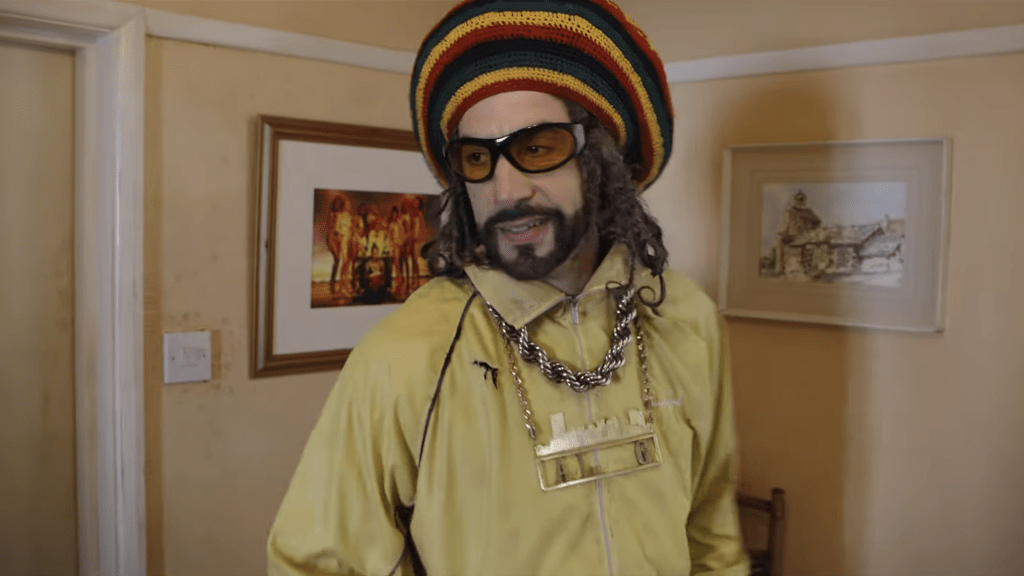
The first trailer for Ali G: Who Iz I? has landed, and Sacha Baron Cohen’s return to one of his earliest and most recognizable personas is already facing a backlash, with some viewers calling for audiences to avoid theaters that book the film.
The preview, which reintroduces Cohen’s faux streetwise interviewer Ali G for a new big-screen outing, was intended to signal a comeback for a character who helped make the British comedian an international name more than two decades ago. Instead, the trailer has reignited a debate over whether the act can still function as satire in a culture far more attuned to race, class and representation than it was during the character’s original run.
Online reaction has been sharply divided. Supporters argue that Ali G has always been a comic construction designed to expose political vanity, media cluelessness and establishment hypocrisy. Critics counter that the character’s exaggerated speech, styling and borrowed cultural signifiers now play differently, particularly in a theatrical marketplace where audiences are more willing to organize quickly around objections to a film’s premise, marketing or star.
The calls for a boycott do not appear to be part of a single centralized campaign, but they have been visible enough across social platforms to become part of the film’s rollout story. Some users have urged moviegoers not only to skip the film but also to pressure local cinemas against programming it, framing the trailer as evidence that the revival is out of step with the moment. Others have pushed back, accusing detractors of judging a feature-length project before seeing it.
A legacy character in a different era
Cohen first broke through with Da Ali G Show, using the Ali G character to conduct absurd interviews with politicians, academics and public figures. The act relied on a collision between Cohen’s in-character ignorance and the seriousness of his guests, many of whom appeared uncertain whether they were being mocked, challenged or simply trapped in a deeply strange conversation.
That formula helped pave the way for Cohen’s later creations, including Borat and Brüno, and turned him into one of the most distinctive provocateurs in modern screen comedy. His best-known work has often depended on discomfort: getting people to reveal their biases, assumptions or willingness to perform for a camera. That reputation remains a major part of his brand.
But comedy built around disguise and social ambush has become more complicated. What once moved through television and multiplexes as transgressive prank satire is now parsed instantly on social media, where context can collapse into a clip and where the marketing of a project may be judged as harshly as the finished film. A trailer, by design, reduces a movie to its broadest signals. For a character like Ali G, those signals are particularly loaded.
The controversy also comes at a time when studios and distributors are increasingly cautious about theatrical risk. Original comedies have struggled at the box office compared with franchise films, horror titles and event-driven spectacles. A recognizable name like Cohen can help sell a comedy, but public resistance can complicate bookings, advertising and premium-screen commitments if exhibitors sense that a title may become a flashpoint.
Why the reaction matters
The dispute around Ali G: Who Iz I? is about more than one trailer. It reflects a broader question facing Hollywood: how should legacy comedy characters be revived when the culture that originally shaped them has changed dramatically?
Studios have been eager to mine familiar intellectual property, from decades-old action heroes to revived sitcom favorites. Comedy, however, is harder to reboot cleanly. Jokes are tied to timing, social norms and the audience’s tolerance for discomfort. A character who once felt like a satirical weapon can later be read as an artifact of the era that produced him.
Cohen’s defenders would likely argue that this tension is precisely the point. His work has rarely been comfortable, and its targets have often included people who underestimate the character standing in front of them. In that reading, Ali G is not an endorsement of the ignorance he performs but a tool for drawing out the ignorance of others.
Still, that distinction may be harder to communicate in a short promotional campaign. The trailer must sell laughs quickly, and the very elements that identify the character — costume, cadence, attitude and cultural pastiche — are the elements drawing scrutiny. In the current marketplace, a studio cannot assume that audiences will extend the benefit of the doubt until opening weekend.
For exhibitors, the situation presents a familiar balancing act. Theater owners are in the business of booking movies that attract audiences, and controversy can sometimes increase curiosity. But campaigns urging patrons to stay away, even if limited, can shape local conversations and create pressure on venues in major urban markets, college towns and culturally engaged communities.
The film’s commercial prospects may ultimately depend on whether the backlash expands beyond social media or remains part of the normal turbulence surrounding a provocative comedian. Cohen has weathered criticism before, and controversy has often been inseparable from the attention his projects receive. The difference now is that theatrical comedy has less margin for error, and audience sentiment can harden long before reviews arrive.
What Happens Next
The next phase will be crucial for Ali G: Who Iz I?. If the filmmakers and distributors believe the trailer has been misread, they may attempt to reframe the campaign with additional footage, interviews or festival positioning that clarifies the movie’s satirical targets. Cohen, who has frequently used publicity appearances as extensions of his comedy, could also choose to address the criticism directly or in character.
Exhibitors will be watching the noise closely, but early online anger does not automatically translate into box office damage. The key indicators will be trailer completion rates, advance tracking, theater commitments and whether the boycott rhetoric attracts backing from larger advocacy groups.
For now, the film has achieved what Cohen’s work often does: it has made people argue before they have seen the final product. Whether that argument becomes a liability or a marketing accelerant will determine how warmly Ali G is welcomed back to the big screen.