
Artificial intelligence is already reshaping how music is made, but industry figures remain divided over whether the technology will expand creativity or push human creators out of the business.
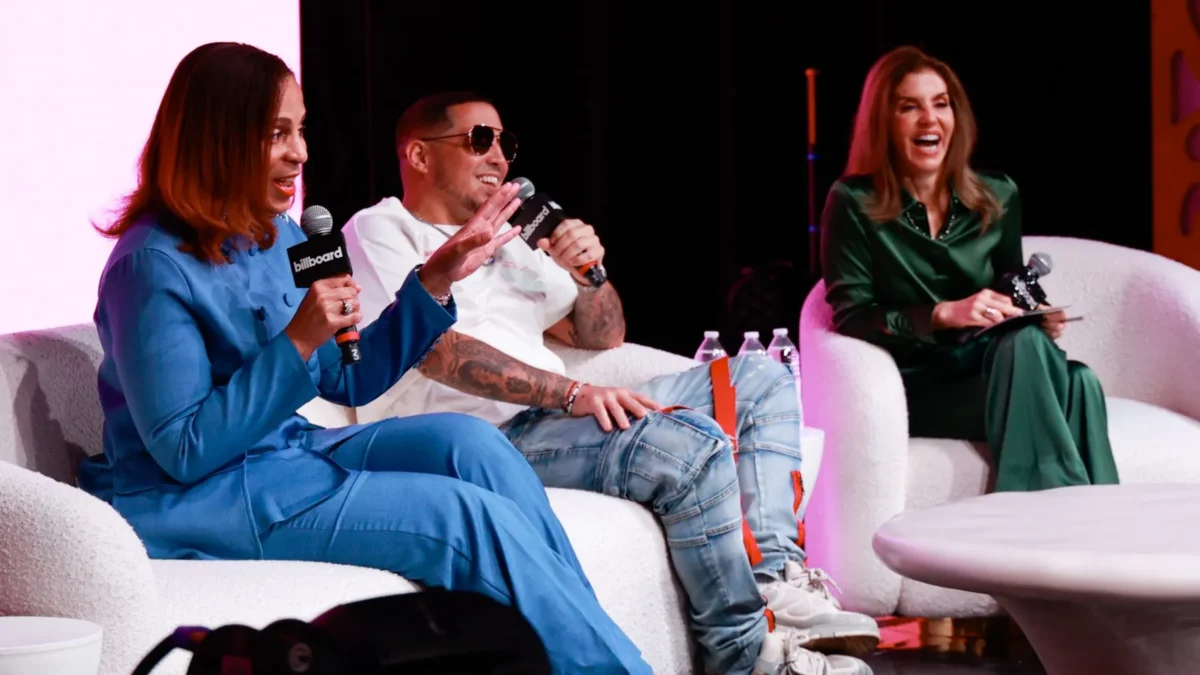
That tension took center stage Tuesday, Oct. 20, during a Billboard Latin Music Week 2026 discussion about AI-generated music and the future of creativity. Cristina Perpiñá-Robert, director general of the Spanish Society of Authors and Publishers (SGAE), called for stronger protections as she warned that existing regulation may not go far enough.
Perpiñá-Robert said Spain’s central concern is not simply how AI systems and their output should be licensed. Instead, she pointed to the possibility that synthetically generated material could replace work that would otherwise go to songwriters and other human creators.
“Our biggest concern is not so much the licensing process,” she said. “It’s the fact that the content which is generated with AI is completely replacing human creators. That’s our concern.”
The debate comes as authorship, copyright and licensing remain among the defining questions surrounding synthetic music. Although many countries and regions already have regulations, Perpiñá-Robert argued that creators and authors are being “completely excluded” from the emerging business model.
“It’s not only how to license the model, it’s how to prevent creators from not being hired anymore because you can just resort to synthetic music,” she said.
AI Is Already Part of the Creative Process
The panel also made clear that artificial intelligence is not a distant prospect for the music business. Perpiñá-Robert said creators in Spain are already using and enhancing their work with AI, even as SGAE raises concerns about the technology’s potential to displace them.
Pierre Hachar Jr., managing partner of The Hachar Law Group and another participant in the discussion, said most of his clients are using AI, whether or not they publicly acknowledge it.
“Some of them are not, but they’re genius-level songwriters and producers and artists that don’t need to use AI, frankly,” Hachar said.
His view of the technology was more optimistic. Hachar argued that technological advances foster growth “whether we like it or not,” comparing the current resistance to AI with earlier reactions to streaming and production tools including Pro Tools, Reason, Logic and FL Studio.
He recalled warnings that those tools would signal “the end of the musician,” but said they instead allowed a new group of people to explore creativity. “And that’s the way I see AI,” he added.
The conversation was moderated by Tatiana Cirisano, MIDiA Research’s vice president of music strategy. Together, the panelists outlined a fundamental divide: AI can function as another tool in a creator’s process, but synthetic music can also become a substitute for hiring that creator at all.
A Wider Debate Over Control
Perpiñá-Robert said approaches in both the United States and Europe favor technology and AI. At the same time, questions about whether powerful AI models could escape meaningful human control and cause harm have become increasingly pressing.
In the United States, President Donald Trump rejected stopping AI development because of concerns that China could gain a technological advantage, according to reporting by the Associated Press.
Within music, however, the immediate dispute is centered on how creators fit into an AI-driven model. The panel’s contrasting positions showed that licensing is only one part of the issue. The discussion also involves who receives creative opportunities and whether AI serves as an enhancement to human work or a replacement for it.
ShowBiz Take
The most significant takeaway is that the music industry is no longer debating AI as a hypothetical tool. Perpiñá-Robert said Spanish creators are using it, while Hachar said most of his clients have adopted it as well. The unresolved question is therefore not whether AI will enter music creation, but under what conditions it will operate.
Hachar’s comparisons with streaming and widely used production software frame AI as another stage in music technology’s evolution. Perpiñá-Robert’s warning identifies a key difference in the current debate: the concern that synthetic content may not merely change how people create music, but reduce the need to hire human creators in the first place.
That distinction places authorship, copyright and licensing alongside a broader question about human participation. Calls for regulation will have to contend with a technology that some creators are already incorporating into their work, even as organizations representing authors seek protections against replacement.
What Happens Next?
The discussion unfolded during Billboard Latin Music Week 2026, which coincides with the 2026 Billboard Latin Music Awards. The awards will air live Thursday, Oct. 22, from the James L. Knight Center in Miami on Telemundo and Peacock.
For AI-generated music, the larger questions raised by the panel remain active: how synthetic works should be licensed, how authorship and copyright should be handled, and whether regulation can protect creators without shutting them out of technology they are already using.