Why This Matters
The extended court order blocking Paramount Skydance’s proposed $111 billion takeover of Warner Bros. Discovery adds a fresh layer of uncertainty to one of the entertainment industry’s most closely watched consolidation battles — and that uncertainty now reaches into the wrestling business.
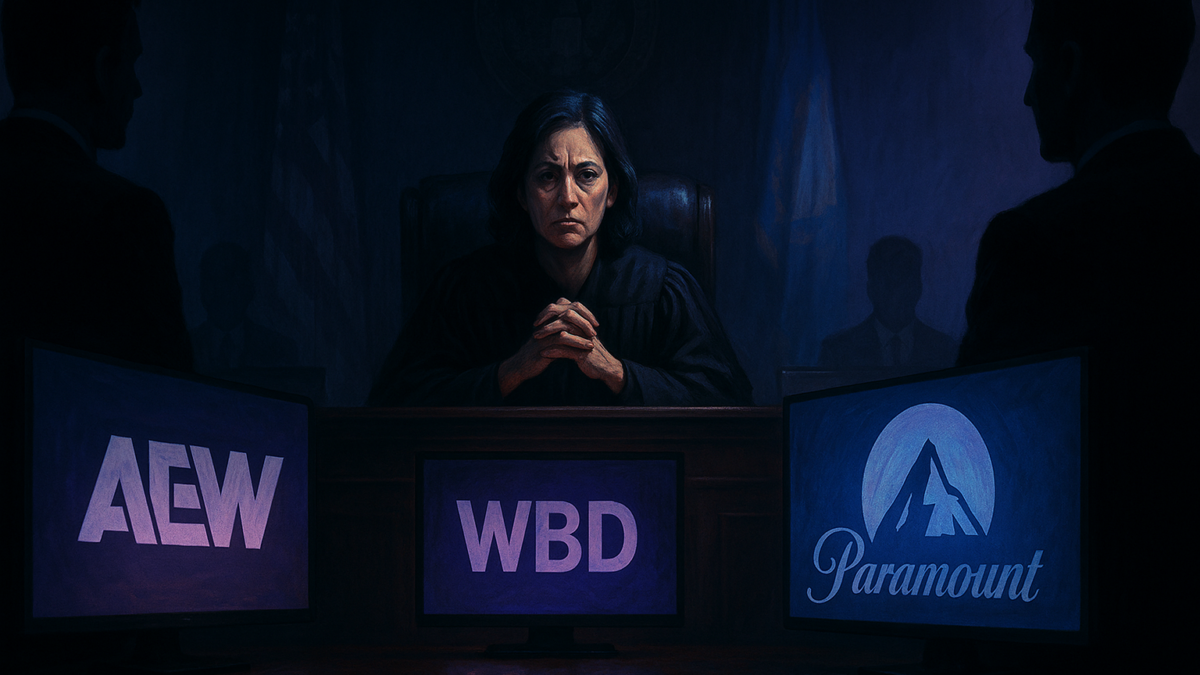
U.S. District Judge Araceli Martinez-Olguin on Thursday extended the temporary restraining order that prevents the deal from moving forward through August 18. The original order had been expected to expire after 14 days, but the extension gives the parties more time to argue over whether a preliminary injunction should be issued. In practical terms, the transaction remains frozen while the court considers whether the challenge has enough legal weight to keep the merger on ice for a longer stretch.
For All Elite Wrestling, the significance is not immediate disruption but strategic ambiguity. AEW’s television identity has been built in large part through its relationship with Warner Bros. Discovery, with weekly programming tied to TNT, TBS and the broader WBD ecosystem. Any major change in ownership, corporate priorities or executive leadership at WBD has the potential to reshape how the company evaluates live sports-adjacent programming, rights fees and long-term scheduling commitments.
That does not mean AEW is suddenly in danger of disappearing from WBD platforms. Television deals are contracts, and large media mergers typically take months — often longer — before their operational impact becomes clear. But the legal delay complicates the timeline. If Paramount Skydance ultimately succeeds in acquiring WBD, a new management structure could reassess programming spend across scripted entertainment, news, sports, unscripted content and live-event properties. If the deal is blocked or slowed significantly, WBD’s current leadership may continue making decisions under a cloud of uncertainty.
That matters because AEW operates in a television marketplace where certainty is currency. Wrestling promotions rely on predictable broadcast homes not only for audience growth, but for talent recruitment, sponsorship sales, international distribution and pay-per-view promotion. A network relationship signals stability to advertisers and performers alike. When that network’s ownership future is contested in federal court, even indirectly, it creates a question the industry cannot ignore.
Industry Context
The entertainment business is in a period where scale is no longer just preferred; it is increasingly treated as survival strategy. Streaming losses, declining linear cable subscribers and escalating sports rights fees have pushed major media companies to pursue consolidation, cost reductions and content portfolios that can travel across multiple platforms. A Paramount Skydance-Warner Bros. Discovery combination would be one of the most consequential media deals in years, bringing together major film studios, cable networks, streaming assets and deep television libraries.
That is precisely why legal scrutiny is intense. Regulators, competitors and other stakeholders have become more aggressive in challenging large-scale transactions that could reshape consumer choice, labor dynamics or market power. The extension of a temporary restraining order is not a final judgment on the merits of the case, but it signals that the court is not prepared to let the transaction proceed while key legal arguments remain unresolved.
For WBD, the timing is especially delicate. The company has spent recent years repositioning itself around cost discipline, high-profile franchises, live sports and streaming integration. Properties that can deliver reliable weekly audiences have become more valuable as traditional cable erodes. AEW fits into that conversation because live wrestling is relatively resistant to delayed viewing, produces consistent hours of programming and encourages social media engagement in real time.
At the same time, wrestling rights are not evaluated in a vacuum. WWE’s long-term media agreements have reset expectations for the category, demonstrating that major platforms still see value in wrestling as a volume-driving, loyalty-based product. AEW, while younger and smaller than WWE, has carved out a meaningful position as an alternative brand with a dedicated fan base and a steady weekly footprint. Its value to WBD has been tied not only to ratings, but to the ability to fill primetime hours with live content that can be promoted across linear and digital platforms.
A merged Paramount Skydance-WBD entity could view that as an asset. It could also decide that overlapping networks, budget pressures or a revised sports strategy require different priorities. That is the unknown. Media mergers often produce winners and losers among suppliers, even when no one publicly frames the process that way. Shows, leagues and production partners can find themselves newly prized — or suddenly expendable — depending on the strategy of the combined company.
For AEW, the broader lesson is familiar across Hollywood: distribution partners matter as much as creative momentum. A promotion can have stars, storylines and live gates, but its ceiling is shaped by where viewers can find it. In an era when networks are merging, streaming services are bundling and corporate balance sheets are being scrutinized, the stability of a television home is part of the product.
What Happens Next?
The next major milestone is August 18, when the extended temporary restraining order is currently set to expire unless the court takes further action. Before then, the parties are expected to sharpen their arguments over whether a preliminary injunction is warranted. If the judge grants one, the merger could be stalled for a much longer period while litigation continues. If the request is denied, Paramount Skydance may regain momentum in its effort to complete the WBD takeover, subject to any additional legal or regulatory hurdles.
For AEW, the near-term approach is likely business as usual. The company can continue producing television, building pay-per-view events and maintaining its relationship with WBD while the legal process plays out. Publicly, the smartest posture is calm; privately, any rights-dependent sports or entertainment company would be tracking the case closely.
The bigger question is not whether this court order changes AEW’s television future today. It does not. The question is whether a prolonged merger fight — or a completed merger under new ownership — alters the strategic environment in which AEW negotiates, expands and positions itself for the next phase of growth.
Until the court provides more clarity, the AEW-WBD relationship remains intact but surrounded by larger forces beyond wrestling’s control. In today’s entertainment economy, that is often where the real drama begins.