
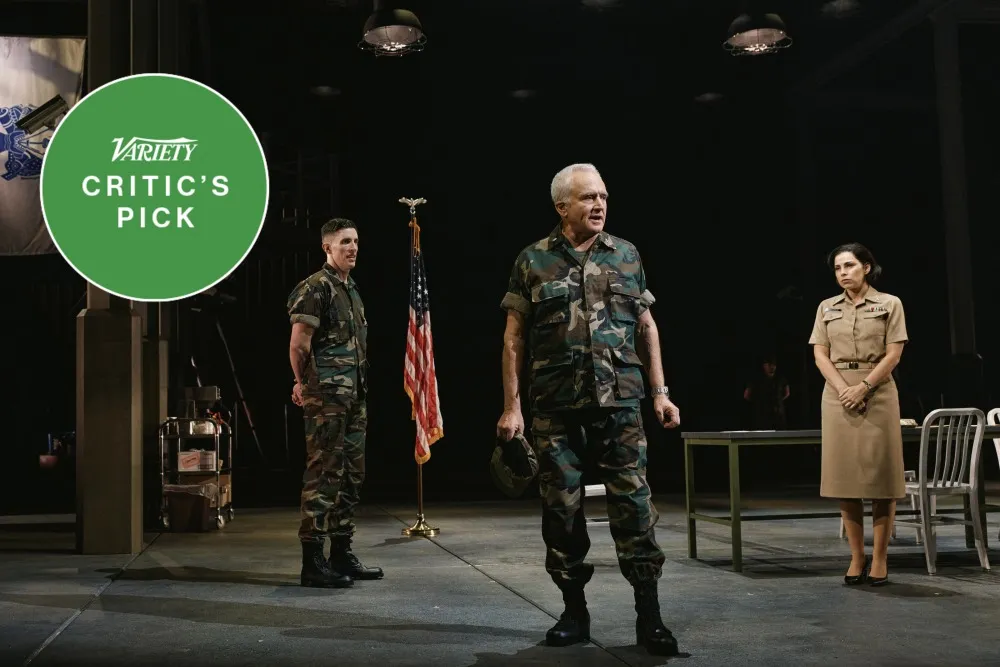
“A Few Good Men” is back on Broadway in a forceful Lincoln Center revival that finds fresh theatrical energy in Aaron Sorkin’s military courtroom drama while leaving some of the play’s age more visible than others.
Directed by Michael Arden at the Vivian Beaumont Theater, the production stars Tom Blyth as Lt. Daniel Kaffee, Krysta Rodriguez as Lt. Cmdr. Joanne Galloway and Bradley Whitford as Lt. Col. Nathan Jessep. Arden’s detailed staging emphasizes the story’s central struggle between individual conscience and institutional obedience.
The drama follows naval lawyers defending two Marines charged with killing another Marine at their Guantanamo Bay base. Lance Cpl. Harold Dawson is played by Lavel Schley, with Collin Kelly-Sordelet appearing as Pfc. Louden Downey.
Galloway believes the death may have resulted from a hazing ritual that went wrong. She pushes Kaffee, the disengaged lawyer assigned to the case, to stop treating the matter casually and confront its stakes. Nick Blaemire plays Kaffee’s associate, Sam Weinberg.
An Outsider at the Center
Arden makes Jo’s position within this male-dominated environment immediately apparent. In an early scene, she remains apart while her male colleagues gather around a table. The costuming builds on that separation: Jo initially wears white as Kaffee and Sam appear in khaki. The color dynamic later reverses, and the characters only begin dressing alike once they have committed to functioning as a team.
Rodriguez gives Jo an upright, tightly controlled physicality, using posture as an expression of the authority her character must continually assert. The nickname “Jo” may be gender-neutral, but the production never loses sight of Joanne Galloway’s experience as a woman fighting to be taken seriously.
Blyth, known for “The Hunger Games” franchise, brings natural confidence to Kaffee. His performance echoes Tom Cruise, who played the character in the story’s 1992 film adaptation, without depending entirely on imitation. Small physical choices, including the way Kaffee rocks back on the rear legs of a chair, help establish the lawyer’s casual exterior.
That ease is central to Kaffee’s journey. He begins as a young man hiding his fear of failure and unresolved feelings about his father behind jokes and professional indifference. Standing among Arden’s rigidly disciplined Marines, he appears comparatively uncertain and diminished. His encounters with Dawson gradually force him to consider what it means to follow his own moral code.
Military Order Becomes Theater
The revival is at its most commanding when Arden turns Marine discipline into a visual language. The service members are frequently positioned with their backs to the audience, making them appear uniform and anonymous. In an early exchange with Kaffee, Dawson and Downey turn downstage only when they are pushed into speaking openly.
A later flashback involving platoon commander Lt. Kendrick, played by John Zdrojeski, expands that idea. The enlisted Marines remain facing away as they march, speak and respond together, becoming a faceless formation rather than a collection of individuals.
The movement makes military drills inherently theatrical: matching uniforms, prescribed gestures and regimented choreography communicate the pressure to comply. The Marines repeatedly invoke their code — “unit, Corps, God, country” — placing the institution’s demands ahead of personal needs. That conditioning complicates any effort to protect the rights of an individual service member.
The result is a clear expression of the play’s larger concern: the distance between justice as an ideal and justice as it is administered inside an organization governed by its own uncompromising rules.
Whitford Moves Into Command
Whitford brings an added layer of history to Jessep, having previously played Kaffee onstage. He now takes over the role associated with Jack Nicholson in the film adaptation: an imperious commander whose certainty in his own righteousness becomes his weakness.
Jessep remains the story’s central antagonist, a sneering martinet undone by hubris. The famous exchange about truth arrives late in the drama, but Arden’s production builds toward it through the clash between institutional power and the lawyers seeking answers.
The 1992 movie, which starred Cruise and Demi Moore, received four Oscar nominations and helped launch Sorkin’s career. It also produced one of Hollywood’s most frequently repeated lines. Sorkin had resisted an earlier revival of the play, making this return especially notable.
Not everything has aged equally well. The play retains Sorkin’s nimble dialogue, quick pace and interest in moral dilemmas, but some of its characterizations can feel overly familiar. Jo may register as a forceful know-it-all, Kaffee’s defensiveness is neatly packaged in wisecracks, and Sam, a new father, is often defined by his Judaism. The script even briefly acknowledges its own verbal artificiality when one of Jo’s superiors questions the way she speaks.
ShowBiz Take
This revival matters because Arden does more than preserve a celebrated courtroom story. He gives its arguments a physical form. Costume colors chart the lawyers’ changing relationships, blocking illustrates exclusion, and military formations reveal how quickly individuality can disappear inside a powerful institution.
While parts of the writing show their age, the production’s disciplined craft keeps “A Few Good Men” alive onstage. Blyth and Rodriguez anchor the legal team from opposite temperaments, Whitford supplies formidable authority, and Arden turns a familiar drama into a visually precise examination of courage, conformity and the dangers of unquestioned obedience.