

Werner Herzog has a bit of a wild reputation. He’d like to set the record straight.
“I’m the most organized, the most focused, the most friendly person you will ever see on a set,” the German director says. “Period.” Everything else, he adds, is “the craze of media who want to create a Werner Herzog that is a fiction.”
This is, of course, the man who hauled a 320-ton steamship over a hill in the Peruvian jungle for Fitzcarraldo (1982), and, on the shoot of Aguirre, the Wrath of God (1972), also in the jungle, threatened to kill his star Klaus Kinski if he walked away from the film [as recounted by Herzog himself in his 1999 documentary My Best Fiend.] This is the man who ate his own shoe after losing a bet to Errol Morris, and who once carried on with a BBC interview after being hit by an air rifle, calling it “not a significant bullet.”
But when Herzog came calling, Kate and Rooney Mara signed up anyway.
The Mara sisters play the leads in Herzog’s Bucking Fastard, as Jean and Joan Holbrooke, Irish sisters who speak, think and move in unison, share the same dreams and love the same man. After their neighbor and former lover Gareth Mulroney (Orlando Bloom) marries someone else, the sisters embark on a campaign of arson, ambush and assorted misdemeanors to win him back, become tabloid fixtures and are assigned a social worker (Domhnall Gleeson) to help them adapt to modern life.
They eventually decamp to Ireland’s West Coast to live with their widowed aunt (Marion O’Dwyer), where they begin chipping away at a cave in a mountain range, convinced the tunnel will lead them to the Orkney Islands, in their minds a mythical place where true love is possible.
The film is loosely inspired by Freda and Greta Chaplin, identical twins from York, in northern England, who spoke in unison and became widely known after a 1981 court case made them tabloid sensations. HanWay Films is handling worldwide sales.
Bucking Fastard premiered in competition at the Venice Film Festival Thursday night, drawing a warm six-and-a-half-minute standing ovation for Herzog and his cast.
Sitting down with THR ahead of the premiere, Herzog and the Maras spoke about their synchronized performance, the film’s surprising vein of “Bavarian humor” and Herzog life lessons in “really not giving a shit.”
Why did you both want to work with Werner Herzog?
ROONEY MARA For every reason under the sun. I would have loved to have just been a PA on the set, just to watch him in action. It’s one of the greatest experiences one can have.
KATE MARA I’ve been fascinated by the way Werner makes films ever since I saw one of his documentaries, so to get to work on a film with him has always been a dream. And then to read his script about these sisters and their bond and this love story was incredibly magical.
There are a lot of stories about the extremes you have gone to on films. Did you have any trepidation?
KATE MARA Zero trepidation about that. The scariest thing for us was just: How are we going to do this? How are we going to do an entire film in unison and in sync in that way? But I had zero worries about working with Werner.
WERNER HERZOG I can tell you why: because I’m the most organized, the most focused, the most friendly person you will ever see on a set. Period. Everything you’re hinting at is the craze of media who want to create a Werner Herzog that is a fiction.
KATE MARA It’s passion. To me, that’s one of the most important things you need in a director — passion, and somebody who cares deeply about filmmaking.
Why did you want the two Mara sisters for this dual role?
HERZOG I had a story, and I thought about whether it should be twins. And I found the two sisters, and it was immediately clear this was finally a solution. I wrote the screenplay very quickly, in five days, and we were done with pre-production in five, six weeks and started to film. We had some rehearsal time, the first time in my life, in all of my films, that there was enough money to do rehearsals. We had two weeks. After a week, I said, “Stop this. Meet me in front of my camera. You’re so good. Stop it.”
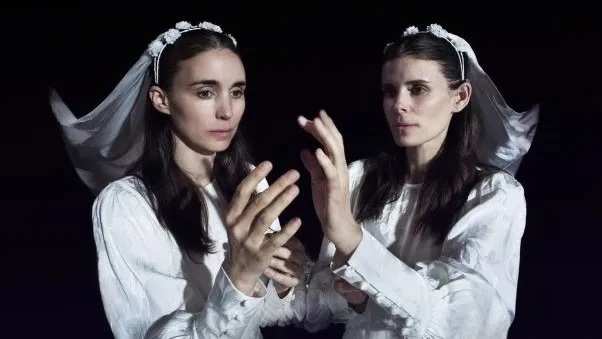
‘Bucking Fastard’ with Rooney Mara, Kate Mara
Courtesy of Lena Herzog
Speaking and moving simultaneously is central to the performances. How did you find a way to do that as actors?
KATE MARA It felt very much like a song, like a rhythm. Once we figured out what that song was and what the rhythm was — which happened way faster than we thought it would — it just made sense to us. It was an unspoken sort of thing. Rooney and I worked a lot together before working with Werner, trying to find our tricks.
ROONEY MARA We had a voice coach we worked with before Werner, who gave us tips, exercises we did together. We weren’t really sure until we got into rehearsal with Werner. We were like, “What the hell are we doing? What is this?” And then when we started doing it in front of him, he liked it so much. It flowed more naturally than we had anticipated.
HERZOG By the way, we did very few takes. I would shoot two or three takes, and that was normally it. Sometimes a single take for a very long scene. Period. I’m a one-camera guy. I do hardly any coverage. There was no coverage. Two shots, and that was it. Two takes.
KATE MARA We would be done hours early sometimes.
HERZOG We finished at 3 p.m., 3:30 in the afternoon. We could have gone until 5, 6, 7 without overtime, and I said, “Let’s wrap it.” I’m not exaggerating, and the film was done under schedule and under budget.
You’ve compared this film thematically to Fitzcarraldo and Grizzly Man. Where do you see the connection?
HERZOG We shouldn’t overdo the connections. But with Fitzcarraldo, it is evident: There is a great dream about opera in the jungle, and for that the protagonist moves a big ship over a mountain in the jungle. Here in this film, it’s the dream of an ideal country, which doesn’t really exist, the Orkneys, where real love is possible — and you would rather dig a tunnel through a whole mountain range to find this country. Everybody should dig a tunnel. Every grown-up man should move a ship over a mountain. Every grown-up woman should dig a tunnel through a mountain range. It’s very simple: Just go out and do it.
That seems to have been your attitude throughout your career, given that you didn’t have a film education.
HERZOG Yes, but I’m not acting blindly. I know what I’m doing. I know that I’m a poet. I dream big, but I do the doable, and that’s what I try to preach to young filmmakers. Yes, dream big, but please do the doable. Moving a ship over a mountain is doable. Digging a tunnel through a mountain is also doable. Do that.
What surprised you about working with him?
ROONEY MARA The specificity. For some reason I imagined things would be a little bit more wild and freewheeling. I didn’t imagine the precision and specificity with which Werner works.
HERZOG I interrupt and say no. Mid-take.
ROONEY MARA Mid-take. Because you had something specific in mind.
KATE MARA Agreed.
You founded your own Rogue Film School, and you have an audience among very young, up-and-coming filmmakers. Why do you think that is?
HERZOG It’s not film students alone, it’s audiences in general. They are very young. I started an Instagram account — my younger son does it, he knows how — and he tells me 85 percent of those who read it and love it are between 15 and 20 years old. Because my films are now available on the internet, on streaming platforms, all of a sudden, from one day to the next, there are 800,000 people who speak about one film of mine. There’s a film club in, God knows, Missoula, Montana, by 15-year-olds, about my films. The answer is simple: They are just very good, and they discover it.
ROONEY MARA I think it’s also that you are a singular human being. You are yourself. You really don’t give a shit. You march to the beat of your own drum so thoroughly, and people love that because that’s what we all want to do. That’s what we all aspire to do. And so many of us are not doing that.
HERZOG But I’m just a poet.
This is the first time you two have appeared on screen together. Why did it take this long?
KATE MARA It’s very difficult to find two roles that are equally interesting and good in a film, and then also find a director that we both passionately want to work with. We found all those things in this. It was really simple. Nothing came our way before that made sense in all areas. We couldn’t really believe it.
What was it like to perform together as sisters?
ROONEY MARA It was a very surreal experience. Strange, because it’s not like we were in scenes playing off of one another the way you normally would with a scene partner. We were playing the same thing. There’s maybe only one scene, and a few moments other than that, where we’re even looking at each other. We are focused on the same thing. It’s really one performance.
KATE MARA We’re experiencing the other actor that we’re in a scene with together. So it’s impossible to compare it to anything else. We’ve never had an experience like that before. It’s great for codependency.
So you’re jointly forming a single performance rather than doing two separate ones.
KATE MARA It’s as collaborative as you could possibly be.
HERZOG It’s unique. We haven’t seen anything like this in film history.

From left: Rooney and Kate Mara in ‘Bucking Fastard.’
Gateway to Orkney
You are best known for collaborations with male actors — Klaus Kinski, Christian Bale, Nicolas Cage. You’ve had a few leading female roles, but not that many. Was the approach different with these two actresses?
HERZOG With every single one, with every single actor, I speak differently. I act differently. I bring them into the film, make them give the inner life of them onto a screen. There’s no school. And by the way, the greatest with whom I ever worked is the unknown soldier of cinema, Bruno S., who plays a leading part in The Enigma of Kaspar Hauser and in Stroszek. He’s the deepest, most tragic one with whom I ever worked. All of the others are actors. He was not.
The film is funnier than some might expect.
HERZOG Thank you that you saw it. There’s always humor in my films, and it came across, apparently. Sometimes it’s a dark humor. Sometimes it’s a very Bavarian humor that even Germans wouldn’t understand. Americans easier. Mexicans, yes, they immediately get it.
Will that surprise audiences?
KATE MARA Werner is one of the funniest people. If you know him and his work, or if you watch him speak about anything, he’s got the greatest sense of humor.
ROONEY MARA We had so much fun. I laughed more than I have in years making this film. We had so many fun moments.
Did it live up to the myth of Werner Herzog?
ROONEY MARA It exceeded it.
HERZOG But from the beginning I told them, I have to load an entire film onto these two shoulders, so that’s big. Are you ready for that? And of course they were. I’m a lucky man that they were immediately ready. Yes, we will carry that.
You are often drawn to extreme characters, figures who exist outside of normal social structures. Is that something you see in yourself?
HERZOG They’re not really borderline. Even in Bucking Fastard, I don’t see them as borderline. They make a lot of sense to me. It’s only unusual that they have apparently one dream together, one love for an undeserving man, and they speak in unison. So that’s unusual. But otherwise, they’re the most normal human creatures for me that you can imagine. They do the thing we all should do.
ROONEY MARA I agree. I think everyone else is crazy. Being willing to show up every day and dig a tunnel through a mountain for love — that’s not crazy. Everyone else is crazy for not wanting to do that.
HERZOG Thank you for saying that, because I keep saying I’m the only filmmaker who is clinically sane. All the rest is not really right.
What can the rest of the film business learn from how he works?
ROONEY MARA There’s so much you could learn from Werner. Again, it’s that willingness to show up as yourself and not be swayed by any of the noise. To have that tunnel vision of, this is who I am, and this is what I’m doing, and this is how I do it, and I’m a poet, period.
KATE MARA It’s very inspiring to watch.
HERZOG The work on my set is like open-heart surgery, only in whispers, going straight for the essential and nothing else. That’s it.
KATE MARA You can hear a whisper from a mile away, and he will tell you so. The set is very quiet, which is great.
HERZOG No cell phones, no video playout, one camera, very few takes. I do the slate.
ROONEY MARA And almost no crew. He does the slate. He’s in there, crawling around within the scene. It’s very special.
You’ve shot in the jungle, the desert, the Arctic Circle, and you’re still making films in your 80s. Where do you still want to explore?
HERZOG I have my next film almost finished. I need a week more and my next film will be finished, so I’m way beyond Bucking Fastard. I’m also finishing a book at Taschen, the publishing house, of photos from my films. So I’m still working a lot. I love what I do.
Is the dream still to go to space and make a film there?
ROONEY MARA What? You want to go to space?
HERZOG Yes, I would like to be out there. I have tried. I spoke to NASA, but they didn’t take me. And then there is a Japanese billionaire who is planning a spaceship around the moon, without landing, returning — he refused to take me on board.
ROONEY MARA We should set up an online petition
HERZOG So let’s wait. Let’s wait for the rocket for me alone. I’ll be on board.
KATE MARA If anyone can do it, you can.
HERZOG By the way, Elon Musk promised me that if he goes on a mission to Mars, I would be on board. But God knows when that’s happening, and I am very critical of his idea of colonizing Mars with a million people. That’s a pipe dream. We will have astronauts there, a handful at a time, and they will explore, but we should not colonize. That’s an obscenity. We should rather keep this planet inhabitable.