

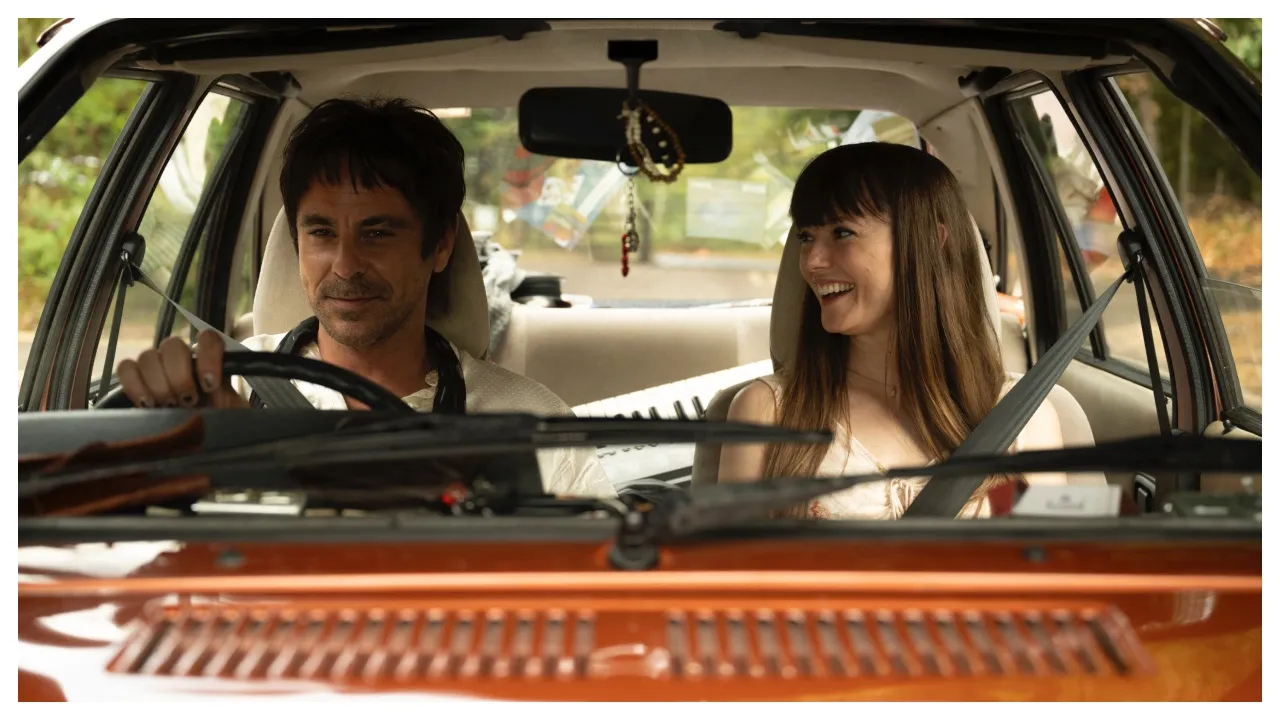
EXCLUSIVE: Here’s a first look at writer-director Josh Appignanesi’s seventh feature Coming of Age, which he co-wrote with longtime collaborator Devorah Baum.
The film, which is told across 30 years of car rides through a fast-changing London, is described as a “heartfelt comedy about the power of aging”. It follows a couple navigating love, parenthood, midlife crises and aging parents, only to discover that getting older might just be the best part.
The film stars Emun Elliott (The Dark, The Gold) as Jay and Lydia Wilson (The Maids, Alice and Steve) as Hannah, the couple at the heart of the story. Further cast include Peter Polycarpou (The Brutalist, House of Dragon) and Tristan Ruggeri (The Twin, The Witcher).
Appignanesi (Song of Songs) and Baum’s script was inspired by research program ‘The Sciences of Aging and the Culture of Youth Project’, a program hosted at King’s College London which explores the concept of aging. The film, which was shot almost entirely on real roads, is produced by Emily Everdee for Lifelong Films, with Sam Buckler co-producing. Martina Zimmerman of SAACY is exec producer. It’s funded by UK Research and Innovation as part of SAACY.
Watch on Deadline
“Age is something we’re always faced with but can’t often bear to face,” said Appignanesi. “It makes fools of us, yet by the same token, deepens us. What would it look like to have the whole tragicomedy of a life reflected back to us in one arc? Might we walk away with something that helped us age a little better?”
Baum added: “Coming-of-age stories tend to be about the journey from childhood into adolescence, while romantic comedies often end just as young people arrive at the altar. But what about the bit of life that comes afterwards? For most of us, that’s rather a lot of life. It’s also in midlife that age can start to feel impossible to ignore, in our bodies, our relationships, our sense of future possibilities…With Coming of Age, we wanted to move the happy ever after a little further down the road – to a point in life when audiences are less used to seeing it.”