
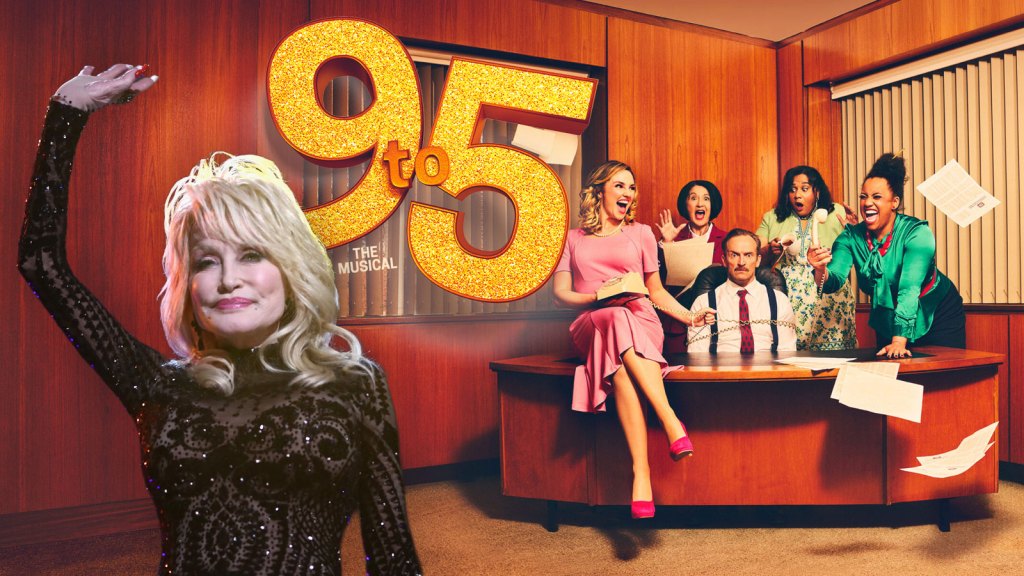
The UK company of 9 to 5: The Musical paused its Tuesday, August 25 performance to honor Dolly Parton, offering an emotional tribute to the country icon, screen star and theatrical songwriter whose fingerprints are all over the stage production.
The cast acknowledged Parton during the show with a message of gratitude that thanked her for “the music, laughter & joy she gave us,” a sentiment that resonated strongly with an audience already gathered to see one of her most recognizable screen creations reimagined for the stage.
The tribute was brief but pointed: a company-led acknowledgment of an artist whose relationship with 9 to 5 spans more than four decades, from the 1980 film that made the title song a working-woman anthem to the musical adaptation that has kept the property alive for theater audiences in the U.S., the UK and beyond.
Parton’s involvement in the stage version is not ornamental. She wrote the music and lyrics for 9 to 5: The Musical, extending the story’s comic energy and workplace satire into a score built around empowerment, resilience and underdog solidarity. For casts performing the show, paying tribute to Parton is also paying tribute to the creative engine behind the production itself.
The moment comes at a time when Parton’s cultural standing remains unusually broad. Few entertainers move as fluidly between country music, Hollywood, publishing, philanthropy and theater, and fewer still have managed to preserve a public image that appeals across generations and political lines. In an industry often defined by reinvention, Parton has sustained relevance by making reinvention look effortless.
That makes any public salute from a 9 to 5 company more than a routine curtain-call gesture. The musical is part of a wider ecosystem built around legacy artists and familiar screen titles, a sector that has become increasingly important to commercial theater. Producers continue to bet on properties with built-in recognition, but 9 to 5 has an advantage many adaptations do not: its original star became the composer, deepening the link between brand and author.
First released as a film starring Parton, Jane Fonda and Lily Tomlin, 9 to 5 arrived as a comedy about sexism, office politics and female camaraderie at a time when workplace equality was a mainstream conversation but still rarely treated with such populist force. Its title track, written and performed by Parton, became an instant signature song and earned major awards recognition, while the film itself endured as a touchstone for women-led studio comedy.
The musical adaptation, featuring a book by Patricia Resnick, opened on Broadway in 2009 and later found a particularly strong afterlife through tours, regional productions and international stagings. In the UK, where screen-to-stage adaptations have long been a reliable part of the commercial theater mix, 9 to 5 has benefited from Parton’s name recognition and from the continued appetite for feel-good, female-driven ensemble shows.
For performers, the show also carries a specific kind of theatrical appeal. Its central trio of women pushed to the breaking point by a toxic boss gives actors comic set pieces, big vocals and a story that remains legible to modern audiences. The humor is broad, but the workplace frustrations beneath it have not exactly disappeared. That continued relevance is one reason the material can still land with audiences well after its original corporate-culture targets were written.
Industry observers have noted that musical theater is leaning heavily on known intellectual property, but the most durable examples tend to offer more than nostalgia. 9 to 5 works because Parton’s music supplies a personality that cannot easily be replicated by a generic adaptation. The songs are not merely decorative; they reinforce the optimism and mischief that made the film endure.
The tribute also underscores the unusually personal relationship audiences have with Parton. To fans, she is not only a performer but a symbol of generosity and self-made success, an artist associated as much with wit and warmth as with chart records. Her Imagination Library literacy program, her business ventures in Tennessee and her decades-long public presence have helped make her one of entertainment’s most trusted figures.
That trust matters commercially. A Parton-associated project carries a kind of goodwill that producers spend years trying to cultivate. In a difficult live-entertainment market, where touring costs are high and audiences are selective, that connection can be a meaningful draw. A tribute from the cast is therefore both heartfelt and strategically resonant, reminding ticket buyers that the production is tied to a living entertainment legacy rather than simply a familiar title.
Tuesday’s acknowledgment also reflects a broader theater tradition: the stage as a place where companies speak directly to audiences in moments of appreciation, remembrance or celebration. Unlike film and television, live performance allows for immediate communal response. When a cast pauses to honor the person behind the work, the audience becomes part of the tribute.
For 9 to 5: The Musical, that connection is especially fitting. The show’s central message is collective action — people discovering their power together — and a company tribute mirrors that spirit. It turns a performance into a shared thank-you, not only to Parton as a celebrity, but to the songs and comic world that brought everyone into the room.
What Happens Next
The UK production is expected to continue its scheduled performances, with the tribute likely to deepen audience interest around the show in the coming days. As 9 to 5 continues to circulate through stage markets, Parton’s role in its endurance remains central: her music is the engine, her persona is the invitation, and her legacy is the reason the story still feels bigger than a night at the theater.