

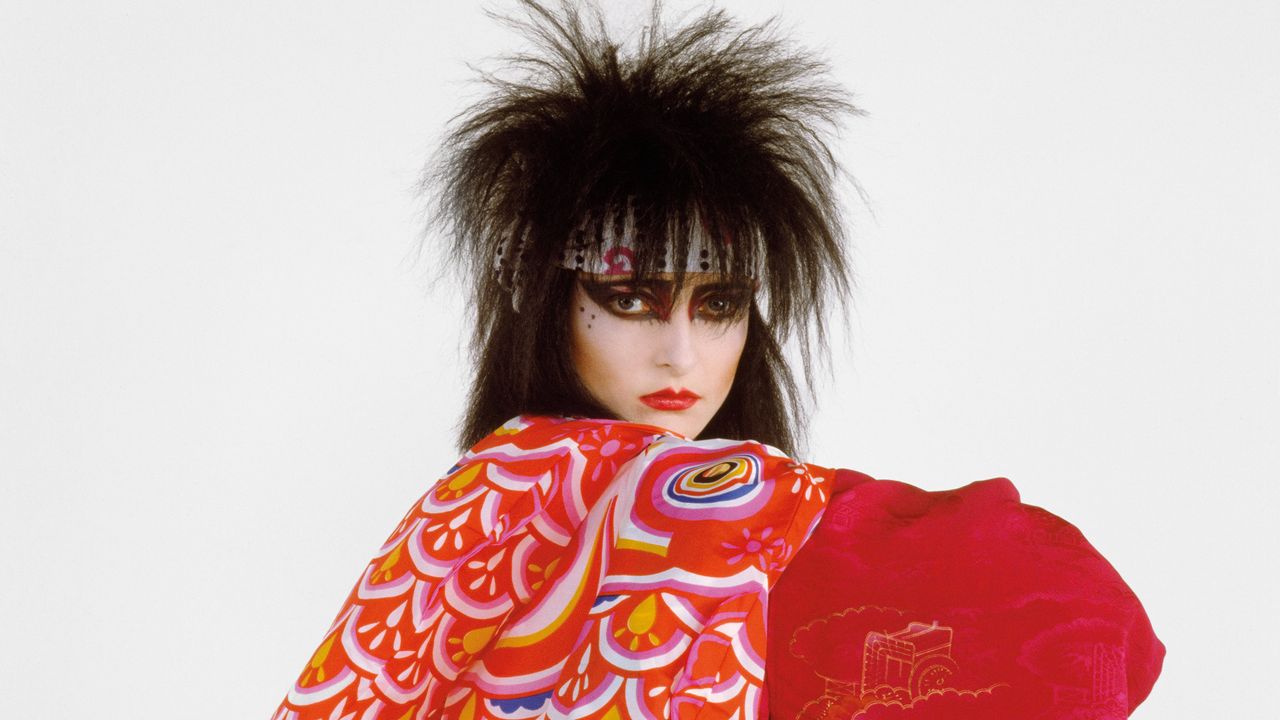
Sheila Rock didn’t think she was going to create some of the most iconic images of the singer Siouxsie Sioux, but fate had other plans—and those images can now be seen in a new book: Siouxsie, Exposures, A Photo Shoot, 1982.
It was late 1981, and Rock—an American photographer then living in London, whose work documented a city deep in the vortex of life during and after punk—happened to see a new collection from the label Johnson’s, designed by her friend Lloyd Johnson. His leather biker jacket with its fetish-y tabs and skull and crossbones buttons was a generation-defining piece of clothing.
The collection was called Rock’n’Roll Suicide, a graphic, almost Dadaist explosion of Japanese flags, rising suns, and Japan’s painterly script worked into tees, shirts, and kimono-like jackets. “Lloyd had transitioned from selling vintage clothing and army surplus to his own designs, and what he was doing was very instrumental in creating a visual look for so many musicians,” says Rock over the phone from her home in Connecticut. “He showed me these Japanese-inspired clothes and immediately I thought of Siouxsie and her incredible look. Over the years, I’ve realized that I am very drawn to things which are alternative and flamboyant. And it was all about timing.”
Indeed, it is—twice over. First, Rock approached the cult British style magazine The Face to see if they’d publish the images: “They’d give you £50 to go off and shoot something, but you’d never know if it would ever run or not,” she recalls, laughing. But it did take the shoot, with Siouxsie gracing the cover of the magazine’s February 1982 issue, one of the five out of 200 total images they ended up publishing. The second moment Rock got the timing just right was when she agreed to revive the whole shoot with the independent publishing company Moonboy.
Her book, co-authored by Ritchie Franklin and Fabrice Couillerot, arrives at a time in the culture when we need all the take-no-prisoners (and, indeed, take-no-shit) heroines we can get—the foresisters of today’s pop disruptors, figures who hit raw nerves as successfully as they made music. Without Siouxsie, there’d be no PJ Harvey, no Shirley Manson, no Charli xcx.
Siouxsie was the face and voice and spirit of the band Siouxsie and the Banshees, a phantasm of her haunting, hectoring vocals against shimmering guitars and drums having the hell mesmerizingly pounded out of them, with songs such as “Love in a Void,” “Spellbound,” “Arabian Knights,” and “Hong Kong Garden,” the latter of which Sofia Coppola used to memorable effect in Marie Antoinette. Siouxsie oscillated, as journalist Sian Pattenden writes in the book’s introduction, “between ice queen, siren, agitator, provocateur, harlequin.” She was also possessed of a memorable look: an arrangement of black jagged hair, kohled eyes, and vermillion lips against pallid skin.