
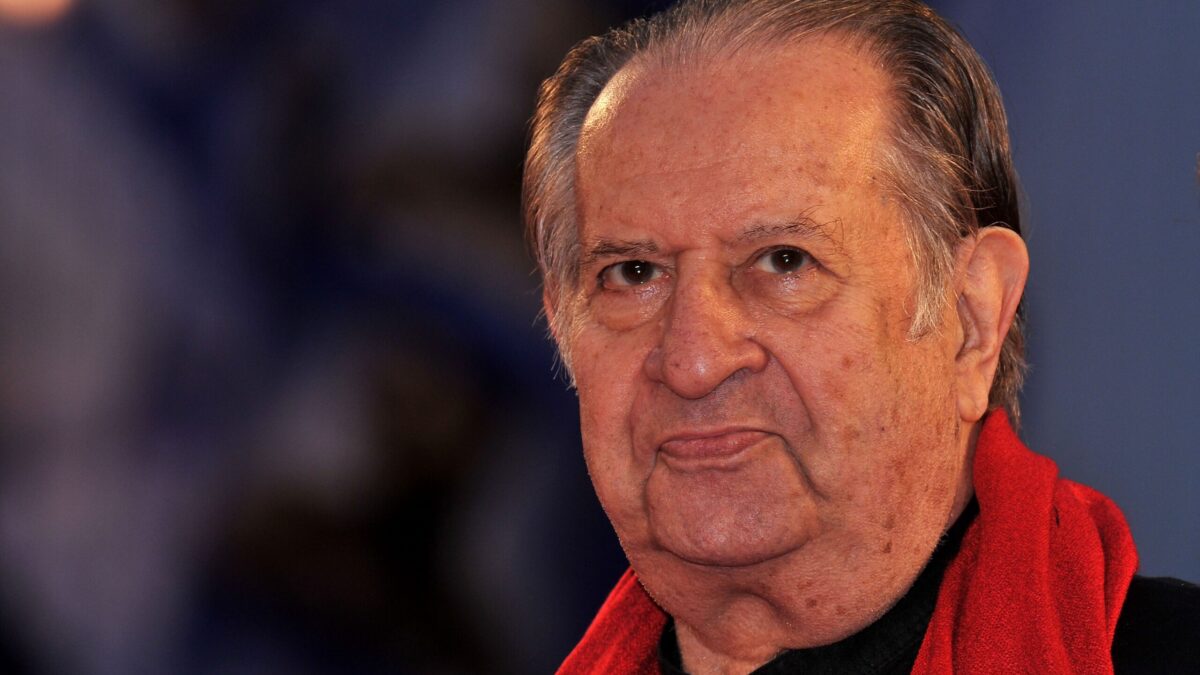
Italian filmmaker Tinto Brass, whose genre-spanning career became internationally identified with a run of provocative erotic films, has died in Rome at the age of 93.
Brass’ wife, Caterina Varzi, and his children, Bonifacio and Beatrice Brass, announced his death Wednesday to Italian press agency Ansa.
Although films including Salon Kitty, Caligula and The Key came to define his reputation abroad, Brass’ work also encompassed experimental shorts, avant-garde filmmaking and thrillers. His career was marked by repeated clashes over censorship and creative control, beginning with his first feature.
From Paris film circles to his directorial debut
Born in Milan in 1933 to a Venetian family, Brass studied law in Padua before relocating to Paris in 1957. There, he became connected to the Cinémathèque française under director Henri Langlois and moved within the circle surrounding the emerging Nouvelle Vague.
Brass also worked as an assistant to filmmakers Joris Ivens and Roberto Rossellini before making his own feature debut in 1963.
That film, the Venice-set In Capo Al Mondo, was later retitled Chi Lavora è Perduto. Centered on an unemployed young man with anti-social tendencies, it drew objections from censors. The dispute became the first in a series of battles connected to Brass’ nonconformist and libertarian creative outlook.
During the 1960s and early 1970s, he concentrated largely on avant-garde work. Among his credits were Tempo Libero and Tempo Lavorativo, two experimental short films commissioned by Umberto Eco.
Brass also spent significant time in London during the late 1960s and early 1970s, where he made three films: Deadly Sweet in 1967, Attraction in 1969 and Dropout in 1970.
Deadly Sweet, a pop thriller starring Jean-Louis Trintignant and Ewa Aulin, follows the brief connection between a disenchanted man and a girl with no illusions after the murder of a London nightclub owner. A restored digital 4K version screened this year in the Venice Film Festival’s Venice Classics program.
The films that reshaped his international reputation
Brass moved into a new period in the late 1970s, drawing wider notoriety for historical-erotic productions. That phase included Salon Kitty, released in 1976, and Caligula, released in 1979. He followed those films with 1983’s The Key, a free adaptation of a novel by Tanizaki Jun’ichirō.
Caligula became both one of his best-known projects and the center of a major creative dispute. With a reported 1979 budget of $25 million, it was described at the time as one of the most expensive independent films ever made.
The production ultimately became the subject of a struggle involving Brass, screenwriter Gore Vidal and producer-financier Bob Guccione, the founder of Penthouse magazine. Guccione added hardcore sex scenes during post-production, prompting Vidal to request that his name be removed from the credits.
Brass also distanced himself from the finished film. He considered Guccione’s additions a betrayal of the vision he had intended for the project.
Decades later, the film was revisited in a different form. Caligula: The Ultimate Cut, a re-edited version that removed the scenes Guccione had added, screened in Cannes Classics in 2023.
ShowBiz Take
Brass’ death closes a career that cannot be reduced solely to the erotic films most closely associated with his name. His beginnings in Paris film culture, his work with Ivens and Rossellini, his experimental projects and his London productions reveal a filmmaker who moved across styles before entering the period that brought him international notoriety.
The recent festival appearances of both Deadly Sweet and the reworked version of Caligula also underscore the continuing interest in different chapters of his filmography. One restoration returned attention to an earlier pop thriller, while the 2023 cut of Caligula revisited the movie at the heart of his most consequential battle over authorship and control.