
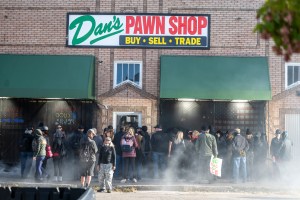
Danny Trejo’s son, Gilbert Trejo, is defending the 82-year-old actor amid backlash over his role in Pawn Shop, a Daily Wire and Bonfire Legend project that has been described as pro-ICE.
Gilbert claims his father did not know Ben Shapiro was involved until filming had already been underway for roughly two weeks. He also said Danny had “never heard of Ben Shapiro” before the production and needed his son to explain who Shapiro was.
In an Instagram Story shared by the San Fernando Valley Sun, Gilbert said his father had been presented with a different understanding of the movie and his character before accepting the job.
According to Gilbert, Danny’s agent characterized the project as “a complicated story about a complicated time, where everyone looks bad except you, the hardworking Mexican shop owner who just wants peace.” Gilbert said his father was drawn to the chance to portray “a good guy.”
Gilbert further claimed that his father cannot publicly criticize Shapiro or the film, or leave the production, without risking a breach-of-contract lawsuit. He also alleged that Danny was unable to release the statement he originally wanted to make.
“He’s handcuffed to this stupid project, and swaths of people have instantly turned their back on him without knowing any of the facts,” Gilbert wrote. He argued that the controversy had driven attention toward Shapiro while prompting people to abandon someone Gilbert described as one of their heroes.
Danny Trejo Rejects Pro-ICE Label
Danny addressed the criticism himself last week, making his position on immigration and ICE explicit.
“Make no mistake. I am a proud Mexican who has always been and will always be a supporter of my community,” he said. “I am also obviously, pro-immigrant. I am not pro-ICE. I know where I come from and I know our struggles. I am an actor. My job is to tell a story.”
The dispute surrounding his involvement comes as Pawn Shop faces scrutiny over both its subject matter and its production in Livingston, Montana.
The movie’s synopsis centers on unrest in Minneapolis. A young federal agent is stranded after his partner is seriously injured and takes refuge in a neighborhood pawn shop. Inside, he becomes trapped with a traditional Hispanic father and that man’s progressive, college-age son. The story brings the three characters into conflict over their fears and beliefs as they confront a dangerous crisis.
The film’s opening scene appears to dramatize the fatal shooting of Renée Good by ICE in Minnesota in January. That apparent connection has contributed to the project being characterized as pro-ICE, although Gilbert insisted the movie is “not overtly pro anything.”
Production Faced Local Protests and Suspension
Residents have protested since filming began, objecting to the alleged use of blank gunfire, pyrotechnics and a staged vehicle crash without adequate notice to nearby residents and businesses. The production’s apparent treatment of Good’s killing has also drawn opposition.
Filming was temporarily suspended earlier in the month. It resumed last Tuesday under a revised permit containing additional conditions for the crew.
Those requirements included maintaining local access to the Livingston Food Resource Center’s food pantry and protecting the public from both the filming of violent scenes and production noise. The production also agreed to respond to complaints involving its private security operation by ensuring that security personnel would not police or harass residents on neighboring public streets.
Shapiro criticized the suspension as “a violation of the First Amendment.” He also called the movie’s opponents “censorious jackasses” who were against free speech.
ShowBiz Take
The controversy now hinges on a crucial distinction: Danny Trejo’s participation in Pawn Shop does not, according to either Trejo or his son, amount to an endorsement of ICE or the politics audiences have attached to the production.
Danny has directly stated that he is pro-immigrant and not pro-ICE. Gilbert’s account goes further, portraying the actor as someone who accepted a role based on the description of a hardworking Mexican shop owner seeking peace, only to learn of Shapiro’s involvement after shooting was already in progress.
At the same time, Gilbert’s explanations about the contract, what Danny knew and when he knew it remain claims made in defense of his father. The production itself continues to carry controversy because of its apparent parallels to Good’s fatal shooting, the local protests and the conditions imposed before filming could resume.
For Trejo, the public response is no longer only about the character he plays. It has become a debate over whether appearing in a politically charged project should be treated as support for its perceived message—something both father and son firmly reject.