
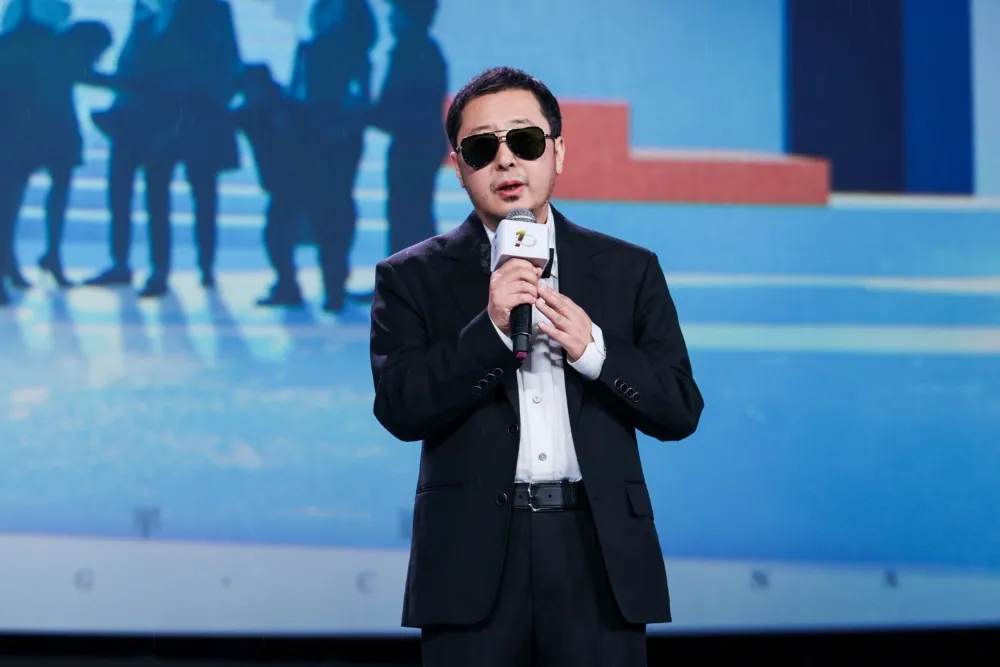
Jia Zhangke is shifting his focus to “Mamma Dunhuang,” a road movie starring Zhao Tao, after the 10th Pingyao Crouching Tiger Hidden Dragon International Film Festival concludes on Sept. 30.
Location scouting and production design are next on Jia’s agenda, with filming scheduled to begin in early winter. Despite artificial intelligence playing a part in the story, Jia has made clear that the technology will not be used to produce the film.
“I will not use AI in making ‘Mamma Dunhuang,’” Jia said. “It only plays a role in the story.”
A cross-country journey to the sea
“Mamma Dunhuang” follows a woman who drives from Dunhuang in western China, near Central Asia, toward the eastern coastline. Zhao will play the homebound protagonist, who turns to AI for help during her journey and continues driving until she reaches the sea.
Jia said his affection for western China, and Dunhuang in particular, helped inspire the film’s expansive route. He described the city as a significant stopping point on the ancient Silk Road, noting both its historical connection to travel farther west and its considerable distance from the ocean.
“So this whole film is a continental story that starts in Dunhuang and travels from the west to the eastern coastline — she drives until the sea comes into view,” Jia said.
The film will reunite Jia with Zhao, who has previously led his work. Zhao won the David di Donatello Award for best actress for “Shun Li and the Poet.”
Although Jia is keeping AI out of the production process on “Mamma Dunhuang,” his broader stance toward the technology remains more nuanced. Earlier this year, he created an AI-generated video, while the festival he founded has previously explored the subject through exhibitions.
Pingyao takes a cautious approach to AI
For its fifth edition, Pingyao partnered with visual artist Xu Bing on “AI-IF,” which invited audiences to create films using artificial intelligence. Jia said the festival’s AI-related initiatives have been presented as exhibitions, and none of the films in this year’s official selection were made with AI.
“We’ve been prudent,” he said, describing Pingyao’s position as open, observant and inclusive. Jia added that technological advances should be understood and discussed rather than avoided, calling the festival’s approach one of “prudent inclusivity.”
That willingness to engage with industry change is also central to Jia’s outlook for Pingyao, which is marking its 10th edition. He said the film ecosystem, media environment and available technology have changed drastically during the festival’s first decade, requiring its organizers to remain flexible.
Jia expects cinema to continue evolving quickly and wants Pingyao to retain the ability to respond to urgent cultural and cinematic conversations. At the same time, he intends to preserve its identity as a gathering place for cinephiles rather than allowing it to become a hall of fame.
The festival’s official program contains 51 films this year. Rather than expanding to the hundreds of titles often shown at international festivals, Jia wants Pingyao to maintain a compact lineup of new boutique films, giving each selection greater visibility and helping it connect with the market.
He also wants the event to foster “a vibe of equality, freedom, and ease,” allowing filmmakers and audiences to mix. Its programming strategy combines artistic value with geographical range, placing particular emphasis on regions that may be less familiar to Chinese audiences. Jia specifically cited northeastern Europe and South America as examples.
Demand tests the festival’s capacity
Interest in the 10th edition has put Pingyao’s physical limitations into sharp focus. Its online ticketing system recorded more than 70 million visits this year, while the ancient city’s protected status as a UNESCO World Heritage Site constrains potential expansion.
Organizers have been working on plans for an additional theater, ideally within the ancient city walls, with a proposed capacity of 300 to 500 seats. Jia cautioned that realizing the project has proved difficult and said discussions are continuing.
Beyond his filmmaking and festival work, Jia also co-founded the Chinese art-house distributor Unknown Pleasures, named after his 2002 film. The company is currently negotiating to acquire two Cannes titles.
In June, Unknown Pleasures announced deals for “Minotaur,” from Russian filmmaker Andrey Zvyagintsev, and “La Gradiva,” the debut feature from French cinematographer Marine Atlan. Jia said the company hopes the films it acquires will receive a strong showcase at Pingyao.
What Happens Next?
Once the festival closes on Sept. 30, Jia is set to move into location scouting and production design for “Mamma Dunhuang.” The road movie is expected to begin shooting in early winter, with Zhao leading its west-to-east journey from Dunhuang to the ocean.