
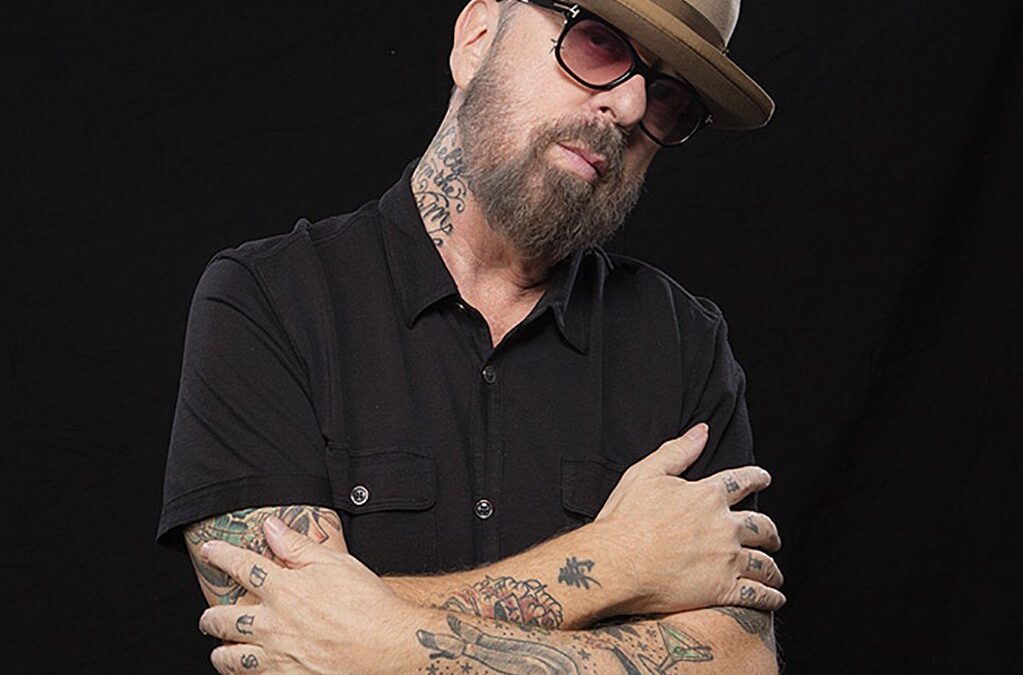
Dave Stewart is preparing to release The Way It Was Back Then on Sept. 18, but the veteran musician says the album did not begin with anything resembling a conventional plan.
Speaking to Billboard via Zoom from the London offices of Rare, an artist’s rights company he co-founded, Stewart said he “didn’t know” he was making an album when the songs first started taking shape at his island studio on Harbour Islands in the Bahamas. The result is a 10-track project he describes as having been built “back to front,” with the core vocal and guitar performances arriving before the full arrangements.
For Stewart, whose recording history spans 47 years across solo work, bands including the Tourists, Eurythmics and SuperHeavy, and production credits for artists such as Bob Dylan, Mick Jagger, Tom Petty and Ringo Starr, the process marked a notable departure. The Rock And Roll Hall of Fame and Songwriters Hall of Fame inductee said the album grew out of an approach similar to last year’s Dave Does Dylan, his solo acoustic covers set.
A record that started as one-take instinct
Stewart said he began by singing directly into the recording setup with acoustic guitar, as he had done on the Dylan songs. “I didn’t have any of the words written down or in my mind; I just sang them stream of conscious, into the mic,” he told Billboard. He said the initial takes captured spontaneous vocal and guitar performances, and in some cases included a small keyboard called an Orchid.
At first, Stewart expected to repair or reshape parts of the recordings later. Instead, repeated listening changed his mind. “Usually you play everything and make a track and then the singer sings on top of it,” he said. “This was the exact opposite. It was very homemade.”
After those first performances were captured, Stewart and engineer Jesse Samler added the rest of the instrumentation around them. Stewart said Samler plays drums “really good,” while both men played bass, keyboards, guitar and whatever else the songs required. The sessions also included “a couple of local ladies” on some high backing vocals; Stewart said one of them “sings a bit in church.”
Despite that improvised beginning, the album is not being presented as a stripped-down sketchbook. The source material describes “Your Wishes,” the album’s second track, as featuring lush orchestrations, while songs including the title track, “The House Where I Was Born,” “Oh Jesse,” “Thin Ice” and “All Done” are described as full-band constructions. Stewart singled out “Black Cat” as one of his favorite songs on the album; during recording, he said, its brief guitar solo was originally about 15 minutes long.
Personal memories and emotional pressure points
The album’s lyrics also pulled Stewart into reflective territory. The title track and “The House Where I Was Born” look back toward his past, with the latter emerging from observations made while he once stayed in the house across the street from his childhood home and visited his old school and parts of the surrounding neighborhood.
Other songs came from more immediate emotional terrain. Stewart said “Cry If You Want” was inspired by one of his daughters’ severe health issues, while “Black Cat” expresses defiant resilience. “I count my blessings and find myself lucky,” he said, “but it doesn’t stop me from having really deep emotional struggles and feelings in my own world.”
Stewart, who is 74, described the album’s off-the-cuff method as a form of musical therapy. He said that with age, the focus shifts toward the feeling of a particular period or moment rather than a strictly detailed account of events. The songs, he said, may refer to places and people, but they are more concerned with the emotion of a time and place than with exact detail.
The unusual recording method has also created a practical challenge: Stewart has concerts in his hometown of Sunderland, England, where he is set to perform the whole album and nothing else. He told Samler, “Hey, I better learn these songs,” because the only time he had sung them was during recording.
Release plans and what comes next
The Way It Was Back Then will arrive in limited physical editions on vinyl and CD through Bay Street Records. It will also be available through Stewart’s Art of Chaos app, which includes other exclusive content.
Stewart indicated the release may expand later, but not immediately. “After it’s been out for a while, I might allow it on other (platforms) that might become available,” he said. For now, he wants the album to be something listeners make an effort to obtain. He is also planning some “pop-up concerts for the U.K.” after the Sunderland shows.
The full tracklist for The Way It Was Back Then is: “The Way It Was Back Then,” “Your Wishes,” “Cry If You Want To,” “The House Where I Was Born,” “Black Cat,” “Makes Me Happy (And Sad),” “Oh Jesse,” “All Done,” “Thin Ice” and “What’s A Man Supposed To Do.”
What began, by Stewart’s account, with uncertainty has become a finished record he now hears with clarity. “My first thought back when we started was, ‘Oh, is this an album?’” he said. “Now hearing it, I’m going, ‘Yeah, it is.’”