
Before on-demand viewing made it possible to find a favorite show at virtually any time, television’s opening credits had an urgent assignment: capture attention before viewers changed the channel. The best sequences did more than display names. They introduced characters, established the setting and delivered a theme audiences would remember long after the episode ended.
That approach stands in contrast to many current streaming intros, which may rely on montages of familiar images. Some modern productions, including the “Matlock” reboot, do not feature theme songs at all.
The sitcoms below represent the ’70s opening sequence at its most effective, pairing memorable music with visuals that conveyed the identity of each series. Here is ShowBiz’s ranking of the five best.
5. “Laverne & Shirley”
Few intros capture friendship and everyday chaos as efficiently as “Laverne & Shirley.” Milwaukee best friends Laverne DeFazio, played by Penny Marshall, and Shirley Feeney, played by Cindy Williams, skip arm-in-arm along a sidewalk, work together at the Shotz beer bottling plant and race around their apartment.
The “Happy Days” spin-off ran for eight seasons and 178 episodes from 1976 to 1983. Although Marshall and Williams dominate the opening, Carmine “The Big Ragoo” Ragusa, played by Eddie Mekka, also appears, as do neighbors Lenny Kosnowski and Andrew “Squiggy” Squigman, played by Michael McKean and David Lander.
The sequence contains relatively few actual credits, naming Marshall, Williams and the show’s producers and executive producers. Instead, it uses its time to preview the title characters and the day-to-day escapades driving the series. Its “schlemiel” and “schlimazel” opening also introduced many Gen X children to those Yiddish terms.
Lander died in 2020. McKean later played Chuck McGill on “Better Call Saul,” receiving an Emmy nomination for the role in 2019.
4. “Mork & Mindy”
Robin Williams’ appearance on “Happy Days” was not intended as a backdoor pilot, but the response to Mork from Ork led Garry Marshall to give the character his own series. “Mork & Mindy” ran for four seasons from 1978 to 1982 and used several opening sequences, though key elements remained consistent.
Mork’s egg-shaped spacecraft makes its way toward Earth, setting up his joyful and sometimes frustrating arrival in Mindy’s life. Boulder is another major visual component, with Mindy’s blue Jeep CJ-5 shown traveling through the Rocky Mountain foothill town.
The intro also makes room for Mork’s “Nanu-Nanu” and “Shazbot” catchphrases and his habit of sitting on his head. Season 1 versions briefly feature Mindy’s father Fred, played by Conrad Janis, and her grandmother, played by Elizabeth Kerr. Later openings include Remo DaVinci, played by Jay Thomas, and Nelson Flavor, played by Jim Staahl. The instrumental theme also shifted from a classical influence toward a funkier sound in Season 2.
3. “M*A*S*H”
The “M*A*S*H” opening balances melancholy music with images of urgency. Its theme is a flute-heavy instrumental version of “Suicide Is Painless,” the main theme from the original movie. The television sequence omits the lyrics, including the line, “the game of life is hard to play, I’m gonna lose it anyway.”
As the series ran for 11 seasons from 1972 to 1983, the introduction evolved largely because of cast changes. Its central images remained familiar: the 4077 Mobile Army Surgical Hospital from the ground and overhead, helicopters bringing in injured soldiers and the medical team moving to treat them.
The desaturated Korean War imagery, stoic personnel and subdued instrumental quickly communicate the show’s setting and the turmoil confronting its characters.
2. “All in the Family”
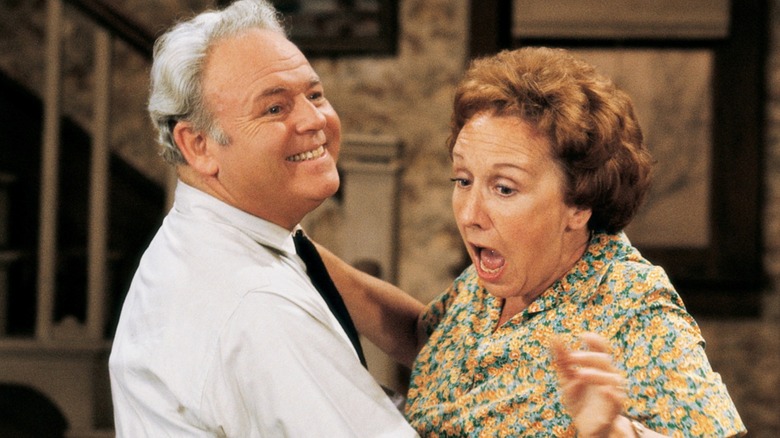
“All in the Family” proves that an opening does not need elaborate staging to become unforgettable. Archie and Edith Bunker, played by Carroll O’Connor and Jean Stapleton, sit together at the piano in their living room and perform “Those Were the Days.”
Archie and Edith were the only characters to appear in all 207 episodes during the show’s 1971-to-1979 run. The head-on view of the pair offers little exposition, and it does not feature their daughter Gloria, played by Sally Struthers, or her husband Michael “Meathead” Stivic, played by Rob Reiner. Yet that tight focus also captures the dynamic between Archie and Edith, particularly Stapleton’s distinctive delivery of “and you knew who you were then.”
1. “The Brady Bunch”
At No. 1 is the opening built around the instantly recognizable line, “It’s the story of a man named Brady,” and the 3-by-3 grid of Brady family members. The theme explains the blended family’s formation while the grid introduces its members visually.
“The Brady Bunch” ran for five seasons from 1969 to 1974, and its opening changed with the cast. The six actors playing the Brady children handled the singing from Seasons 2 through 5, replacing the Peppermint Trolley Company heard in Season 1. The lyric “that’s the way they became the Brady Bunch” consequently became “that’s the way we became the Brady Bunch.”
Across five versions of the sequence, the children’s maturation provides the most noticeable visual evolution. Its staying power extends beyond the original series: “The Simpsons” parodied the grid format in a Season 7 couch gag, underscoring how firmly the Brady introduction became embedded in television culture.